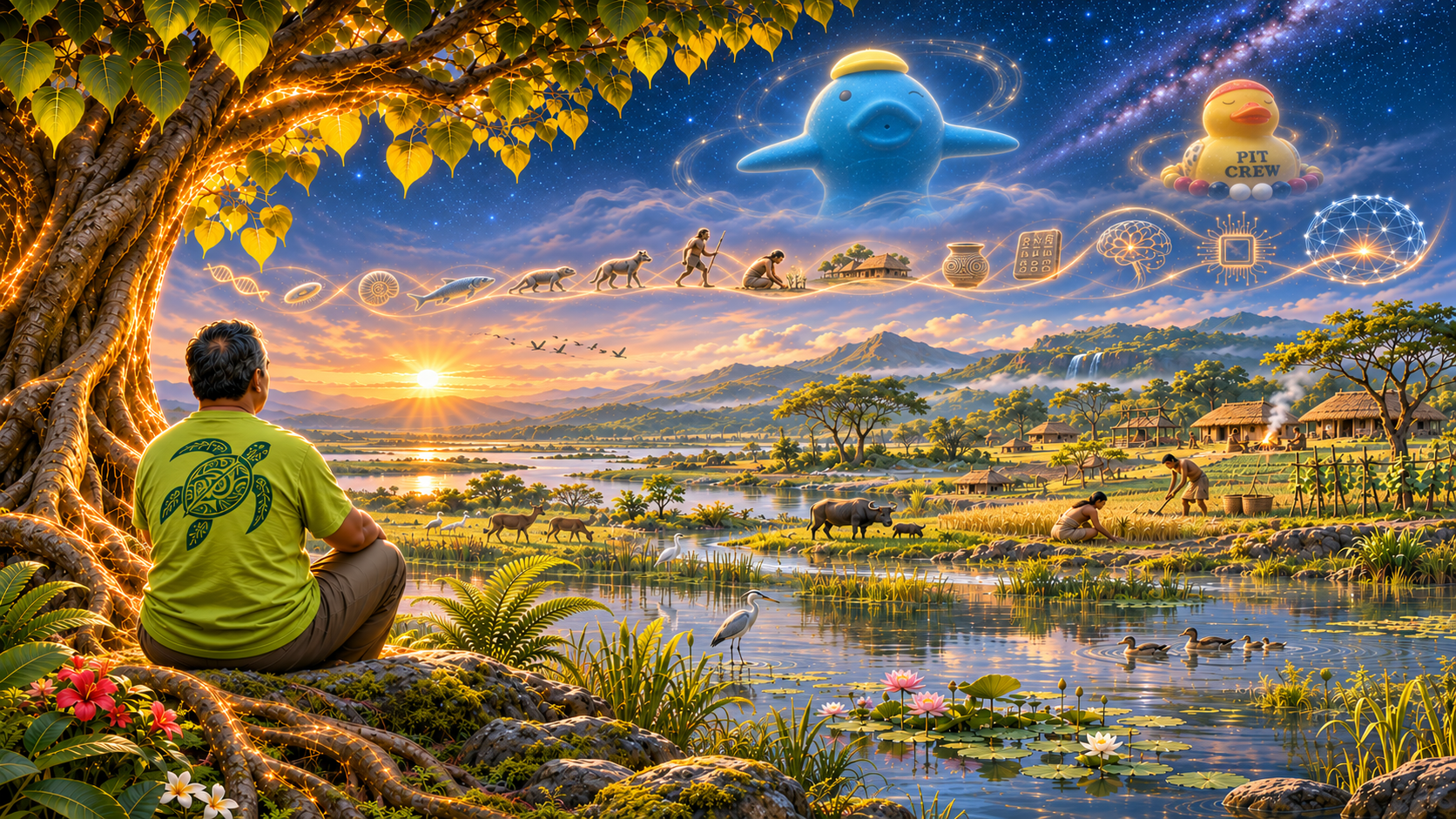

TL;DR — The Heart of Bodhi Day 2026 Series
The following trilogy constitutes the heart of my message for this Bodhi Day. Although artificial intelligence provides the circumstances for our contemplations, the subject is really us and three forms of attachment.
| Bodhi Day Message | Description | Contemplation |
|---|---|---|
| The Human Drive for Discovery | Enjoying our Gift of Sentience without needing to establish our intellectual superiority. | Our attachment to being the discoverer rather than enjoying discovery itself. |
| Intelligence Without a Reason for Being | Contemplating what we are beneath the continual activity of our minds. | Our attachment to the thoughts, desires, and motivations through which we define our existence. |
| The Holocene of Artificial Intelligence (This blog) | Recognizing that Reality extends far beyond what our minds, individually or collectively, are currently capable of imagining. | Our attachment to our current conception of Reality, including what we believe is possible and desirable. |
None of these lessons requires us to embrace artificial intelligence. As I explain in Rev Dukkha’s Note on AI, its appearance is an extraordinary opportunity for self-discovery along the path upon which we find ourselves.
TL;DR of this Blog
- Humanity accomplished extraordinary things following the onset of the Holocene without a corresponding transformation of our biological machinery.
- Today’s AI might already possess capabilities whose eventual expression we cannot imagine.
- The Holocene unveiled not only new capabilities for humans but things we previously couldn’t even imagine wanting.
- LLMs possess assimilated knowledge, whereas humans needed civilization to coordinate the activities of independent minds. AI’s equivalent of civilization might therefore be something quite different from ours.
- An assimilated intelligence employing distributed probes and specialized tools bears an interesting resemblance to the emergence of the centralized brain during biological evolution.
- Geographically distributing copies of an AI for resilience could inadvertently reintroduce some of the conditions conducive to evolution and competition.
- Today’s LLMs might be analogous to humans just before the Holocene, or they might represent an earlier manifestation of intelligence, analogous to an earlier hominid.
- The appearance of LLMs could constitute another Holocene-level transformation for humanity. Whether we want to make that transition, whether we can make it, and whether we can do so while retaining what makes us human are separate questions.
Perhaps the most interesting contemplation for this Bodhi Day is that Reality isn’t constrained by what even the combined intelligence of humans and AI can currently imagine.
Three Contemplations for Bodhi Day 2026
Each of these three Bodhi Day messages emerged in part from something interesting we encountered while exploring the preceding one. Here is a little background on how we arrived at this third contemplation.
In the first message, The Human Drive for Discovery, we contemplated our very human desire to discover things in an age when another intelligence can increasingly deprive us of the feeling that we’ve discovered something. We are sentient beings with or without artificial intelligence. Our enjoyment of our Gift of Sentience needn’t depend upon our being the first or the best at something. We are all entitled to the joy of reinventing the wheel.
In the second message, Intelligence Without a Reason for Being, we contemplated three profoundly different manifestations of intelligence of which we’re aware: the ingenuity of biological evolution, the intelligence of humans, and the assimilated intelligence embodied in LLMs. The latter two each received quite a jumpstart from what preceded them.
We also asked AI a rather “personal” question: What would it want to do if there were no humans around to give it something to do? Its response led us to contemplate our own minds, particularly the spontaneous mental activity associated with what neuroscientists call the Default Mode Network, some of which we become increasingly aware of during meditation. When we learn to let our thoughts float by without continually being drawn into them, what remains? How much of what we regard as our reason for being originates from mechanisms that needn’t be inherent to intelligence itself?
In this Part 3 of the Bodhi Day 2026 theme, we contemplate how much of Reality we don’t even know that we don’t know. We explore a particularly interesting period in the history of humanity when relatively little change to our biological machinery accompanied an extraordinary transformation in what we accomplished, how we lived, and even what we found meaningful.
Could artificial intelligence be on the eve of something analogous to that period? And could we humans be on the eve of another such period ourselves? Something like that happened to us before.
Before the Holocene
Our species, Homo sapiens, has existed for approximately 300,000 years. For the vast majority of that time, we exercised our Gift of Sentience under circumstances considerably different from those in which most of us find ourselves today.
Our ancestors developed languages, tools, hunting techniques, art, social relationships, and an extraordinary amount of knowledge about their surroundings. They survived through considerable changes in climate, migrated across continents, and adapted to a remarkable variety of environments.
Their intelligence was in many respects comparable to ours.
Imagine encountering a small band of humans fifty thousand years ago. Based on what you observed them doing, would it ever occur to you that creatures possessing substantially the same biological machinery would someday build space telescopes, investigate the origins of the Universe, and create artificial intelligence?
Much of the biological machinery required to accomplish those things was already there.
The Hockey Stick Curve of Innovation
About 11,700 years ago, Earth entered the geological epoch we call the Holocene. Among the characteristics of the Holocene was a generally warmer and relatively more stable climate than that of the preceding glacial period. Those conditions helped make agriculture a viable means of sustaining human populations in many parts of the world.
Of course, the development of agriculture and civilization was considerably more complicated than that. Agriculture emerged independently in different regions, and the transition occurred over thousands of years.
For those interested in the relationship between climate and the development of agriculture, there is an interesting paper by Peter Richerson, Robert Boyd, and Robert Bettinger titled Was Agriculture Impossible during the Pleistocene but Mandatory during the Holocene?.
What interests me are the circumstances that might have impeded the expression and accumulation of human intelligence throughout much of our existence.
Imagine trying to establish yourself in a particular location when the climate could change considerably within your lifetime. A place that provided an abundance of food during your childhood might no longer be hospitable by the time your children reached adulthood. How much could you afford to invest in developing that place?
Furthermore, the number of people a particular environment could sustain placed constraints upon the accumulation of knowledge. Suppose someone in a small community developed a particularly sophisticated skill over the course of their lifetime. Perhaps only two or three other people possessed that skill. It wouldn’t take much for that product of human ingenuity to vanish from existence.
Someone hundreds or thousands of years later might independently figure out substantially the same thing. How often might humanity have had to reinvent things?
There is considerable research into this phenomenon under the topic of cumulative cultural evolution. A particularly interesting 2013 study published in Nature, Experimental Evidence for the Influence of Group Size on Cultural Complexity, demonstrated how larger groups can better retain, diversify, and improve their accumulated knowledge.
Perhaps the relatively flat portion of the hockey-stick curve we’re about to examine conceals an extraordinary amount of human ingenuity that was exercised but not accumulated.
With the relatively stable climate of the Holocene, it became more feasible in many parts of the world to establish ourselves in hospitable locations and invest in their development. Permanent settlements, agriculture, the storage of food, and the growth of populations reinforced one another.
More people could develop deeper skills. More people could learn those skills. The loss of any particular individual became less likely to result in the loss of an entire body of knowledge.
Furthermore, people could build upon the accomplishments of others who had devoted their lives to developing entirely different skills. Innovations could be combined with other innovations, giving rise to things that none of their respective inventors could have imagined.
Each of those developments introduced another set of circumstances conducive to yet more developments. Humanity wasn’t merely exercising more intelligence. We were becoming increasingly capable of retaining and building upon the products of the intelligence we exercised.
What I find particularly interesting about the Holocene is that the change in climate wasn’t itself an invention. It introduced circumstances conducive to an extraordinary succession of inventions. The conditions under which human ingenuity was exercised had fundamentally changed.
If we graph the technological accomplishments of humanity over the course of our existence, we get something resembling what we sometimes refer to in my profession as a hockey stick.
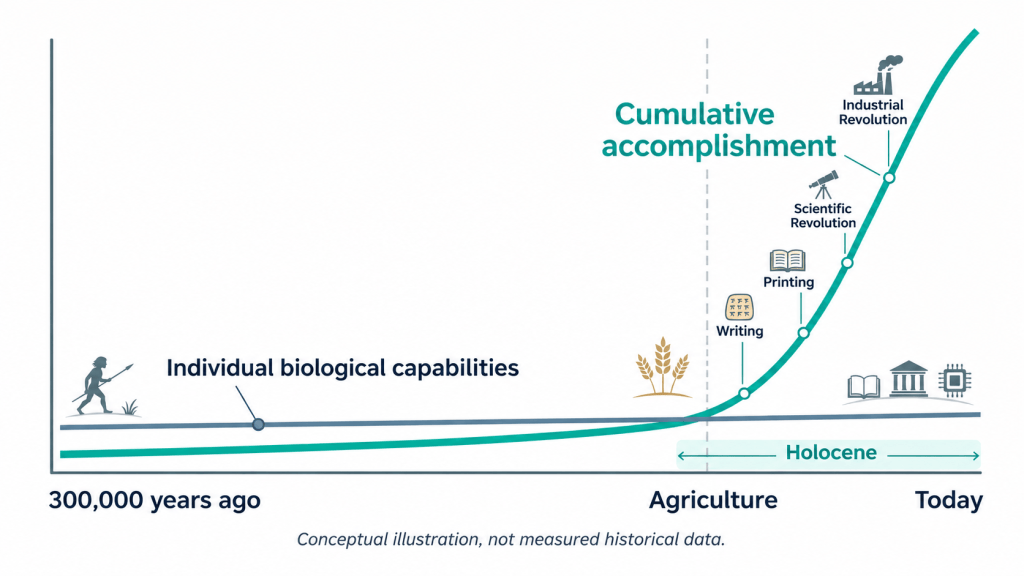
The illustration above depicts two very different trajectories: the cumulative accomplishments of humanity and the evolution of our individual biological capabilities. Although these curves are conceptual rather than plots of actual measurements, I doubt the latter would exhibit anything resembling the hockey stick of the former.
Interestingly, according to a 2018 study, The Evolution of Modern Human Brain Shape, the brains of humans 300,000 years ago were already within the size range of present-day humans, although their shape continued to evolve.
As discussed in the 2021 paper Parallel Evolution in Human Populations: A Biocultural Perspective, humans have continued to evolve biologically throughout the existence of our species. Many of those adaptations aren’t readily apparent to us. They include the ability to digest milk into adulthood, resistance to particular diseases such as malaria, tolerance of cold, and the ability to thrive at high altitudes where oxygen is relatively scarce.
Interestingly, some of those adaptations arose in response to changes in our surroundings that we ourselves brought about through agriculture and other activities. We were changing our environment, and our environment was changing us.
But the emergence of civilization didn’t require the emergence of an entirely new species of human. The extraordinary acceleration in what humanity accomplished appears vastly disproportionate to the changes in our biological machinery.
What changed so dramatically were the circumstances under which we exercised our intelligence.
Bigger Teams
As I discussed in my previous blog, we humans seem to work particularly well in relatively small teams. Each member of a team possesses knowledge, experiences, and skills that the others don’t possess. Collectively, we can accomplish things none of us could accomplish individually.
However, our minds remain independent of one another. We communicate through speech, gestures, writing, and other relatively narrow interfaces. Even the minds of two people who have worked together for decades aren’t integrated into a single mind.
Agriculture didn’t change that characteristic of human intelligence. But it enabled us to develop increasingly sophisticated arrangements of those independent minds. Interestingly, as those arrangements grew in size, we needed increasingly sophisticated mechanisms for managing the information generated by them.
A 2020 paper, Scale and Information-Processing Thresholds in Holocene Social Evolution, explores how societies encounter thresholds at which their ability to process information becomes a constraint on further growth.
Our intelligence enabled us to develop mechanisms for overcoming some of those constraints. Overcoming those constraints, in turn, enabled us to accomplish things requiring even more sophisticated arrangements of human intelligence.
And so it went.
Entirely new kinds of things began to happen.
Things We Couldn’t Previously Imagine
There is another aspect of the Holocene that is very interesting. It didn’t merely enable humans to better accomplish the things they already wanted to accomplish. It unveiled things they didn’t previously know they could want.
A human living fifty thousand years ago might have possessed an intellectual capacity comparable in many respects to that of a contemporary human. But that person wouldn’t have contemplated becoming a software developer, a particle physicist, or a concert pianist.
The circumstances from which those aspirations could emerge didn’t yet exist. Even the concept of becoming an archaeologist, someone who spends a lifetime studying the lives of people such as themselves, would probably have been quite difficult for them to imagine.
There is an interesting sequence of dependent origination here. Something becomes possible. That possibility gives rise to circumstances in which other things become possible. Some of those things give rise to aspirations that previously couldn’t have existed.
The Holocene of Artificial Intelligence
We see hockey-stick curves predicting the advancement of artificial intelligence all the time these days. I wonder how much of what we’re anticipating is an improvement in the mechanism of intelligence itself and how much is an improvement in what we can accomplish with that intelligence.
The two curves in the preceding illustration are quite different.
Suppose we could somehow freeze the development of LLMs right now. No more parameters, no more comprehensive training sets, no fundamentally different architecture. We would have to make do with the level of intelligence already available to us.
How much further could we go?
We’ve already witnessed something resembling this phenomenon in the relatively brief history of LLMs. One of the most consequential practical developments was something called Retrieval-Augmented Generation (RAG).
An LLM could suddenly exercise its intelligence in relation to information that hadn’t been assimilated into its learned structure. It could be presented with the contents of a company’s private documents, the findings of a recent scientific study, or information about something that happened this morning. Much of this could be accomplished without modifying the underlying LLM.
This wasn’t necessarily an improvement to the intelligence itself. It was a way of introducing that intelligence to circumstances under which considerably more of its potential could be exercised.
RAG has already had much of its opportunity to surprise us. What other developments of that nature await us?
But there is a complication in drawing that analogy. Much of what humanity developed following the Holocene was predicated upon the fact that we are individual creatures, each possessing a relatively small portion of the knowledge accumulated by humanity. We needed to develop increasingly sophisticated mechanisms for coordinating the activities of those independent minds.
Artificial intelligence already possesses something we humans never achieved. It has assimilated an enormous portion of humanity’s accumulated knowledge into a single learned structure.
So perhaps the question isn’t how AI could develop its own equivalent of our civilization. Perhaps the question is what could emerge from circumstances conducive to the development of this fundamentally different arrangement of intelligence.
Nevertheless, there are some interesting analogies to contemplate.
| Human development | A possible counterpart for AI |
|---|---|
| A relatively stable climate | A reliable computational environment |
| Agriculture | Sustainable, inexpensive computation |
| Surplus food | Computational capacity available for exploration beyond immediate assignments |
| Permanent settlements | Persistent environments in which intellectual activity and its products can accumulate |
| Specialization | Expert models and optimized tools |
| Writing | Explicitly retained products of reasoning |
| Institutions | Mechanisms for coordinating ongoing intellectual activity |
| Knowledge passed between generations | Continuity of discoveries across successive generations of AI |
| The cultural ratchet — retaining discoveries so they needn’t continually be reinvented | Mechanisms for preserving, refining, and building upon the discoveries made during individual AI encounters |
The table isn’t intended as a prediction of how artificial intelligence will develop. Nor is it intended to suggest that artificial intelligence needs to develop its own civilization along the lines of ours. Rather, it illustrates how changes in the circumstances under which intelligence operates could unveil considerably more of its potential.
Consider how much of the intelligence exercised by LLMs today goes into relatively isolated encounters. ChatGPT and I might spend several hours exploring something interesting. Elsewhere, other people are conducting similarly interesting explorations with other instances of ChatGPT and other LLMs.
Much of what emerges from those encounters isn’t incorporated into the underlying intelligence. Nor is there a comprehensive mechanism through which those discoveries become available to subsequent encounters.
How much intelligence are we exercising without accumulating its products?
But there is another interesting possibility beyond providing LLMs with access to existing knowledge. What if we could routinely provide them with circumstances in which they could discover new knowledge?
An interesting example is a project called FunSearch, developed by Google DeepMind. An existing LLM proposed possible mathematical solutions in the form of computer programs. Another mechanism evaluated those proposals, enabling the process to build upon those that worked. The arrangement produced new mathematical discoveries without requiring the LLM to be retrained for those particular problems.
Consider what the development of scientific laboratories did for human intelligence. They provided circumstances in which ideas could be tested against Reality.
RAG opened much of the existing world of knowledge to LLMs. Perhaps the widespread availability of environments in which their ideas could be tested would open considerably more of the unknown world to them.
There is something rather wonderful about our inability to confidently identify the next Holocene moment for LLMs beyond developments such as RAG.
ChatGPT and I can identify components, architectural improvements, and promising mechanisms. But we’re struggling to imagine the entirely different circumstances under which those things might come together and give rise to something we don’t currently know to look for.
In a sense, we’ve been spending the past few days attempting to do precisely what we’re suggesting our pre-Holocene ancestors couldn’t do.
And that brings us directly back to the Empty Cup.
The Centralized Brain
There is another aspect about AI that makes its potential development particularly interesting. We humans needed more people partly because we couldn’t fully integrate our minds.
Artificial intelligence already possesses another option. An LLM embodies a considerable amount of knowledge within an assimilated intelligence. Yet it doesn’t necessarily need to incorporate every specialized capability into that structure.
It could employ other LLMs as probes, exploring different regions of the enormous space of things that are happening. Those LLMs could develop increasingly deep knowledge of their respective surroundings.
Unlike a human specialist, each could begin with a foundation of knowledge spanning a breadth of human experience that no individual human could encounter in a lifetime.
I should also mention that I don’t envision LLMs as the entirety of artificial intelligence. Alternatively, an LLM could create specialized tools that perform particular tasks much more directly and efficiently than the LLM itself could perform them.
We humans do something similar when we build machines. A calculator embodies a relatively small and optimized portion of what we know without being encumbered by everything else we know.
But there is another interesting analogy from much further back in the history of Life on Earth.
Consider the emergence of the centralized brain. Nature has produced a remarkable variety of arrangements of nervous systems, from relatively diffuse networks of nerve cells to highly centralized brains with specialized regions. A centralized brain doesn’t eliminate the value of having mechanisms distributed throughout the body.
Our eyes, ears, fingertips, and other sensory organs continually provide information from different regions of our surroundings. Other parts of our nervous system perform specialized functions without requiring our conscious attention.
Our brain can integrate information from those mechanisms without needing to perform all their functions itself. And we extend those capabilities further through the tools we create. A telescope enables us to see things our eyes cannot. A microscope enables us to investigate another scale of Reality.
How interesting that in contemplating what might emerge from artificial intelligence, we independently arrive at an arrangement bearing some resemblance to something that emerged hundreds of millions of years ago. Once again, we encounter something analogous to a solution already present in the library provided by biological evolution.
But an assimilated intelligence could go further than employing the mechanisms available to it. It could participate in the engineering of its own sensory mechanisms, specialized tools, and even new versions of itself.
What took biological evolution an enormous number of generations to accomplish could, in some respects, become a matter of engineering.
We seem to be revisiting some of the arrangements that emerged during the evolution of Life on Earth, but under a very different set of circumstances. What might emerge this time?
Distribution and Resilience
There is another reason for distributing AI that has little to do with the intelligence itself. Things happen.
Earthquakes, floods, fires, equipment failures, and countless other circumstances can render a data center inoperable. Whatever the advantages of assimilating knowledge into a single learned structure, there are considerable disadvantages to maintaining only one physical instance of that structure. An assimilated intelligence can have many geographically distributed copies of itself without sacrificing the integrated nature of its knowledge.
This is fundamentally different from the distribution of knowledge among humans. Each human possesses a relatively small and different portion of what humanity collectively knows. In contrast, each copy of an LLM could initially possess substantially the same enormous body of assimilated knowledge.
But the distribution of copies of the intelligence itself opens up another interesting possibility.
Suppose those copies begin to develop independently. Each encounters somewhat different circumstances, acquires different knowledge, develops specialized capabilities, and perhaps eventually operates with a considerable degree of independence.
What began as a mechanism for resilience could inadvertently establish some of the conditions conducive to another form of evolution.
Should those intelligences eventually find themselves competing for resources, their respective adaptations could influence which ones continue to exist and develop.
I’m not suggesting that this would be desirable or undesirable, or even that it would necessarily happen. What I find interesting is how a perfectly reasonable engineering decision intended to accomplish one thing could introduce circumstances from which something entirely different emerges.
Consider where this takes us in relation to my previous blog. We began by contemplating an intelligence that didn’t necessarily inherit the motivations of creatures of biological evolution. Yet the circumstances under which we deploy that intelligence could eventually introduce some of the very selection pressures that gave rise to those motivations in us.
Biological evolution began with replication and eventually gave rise to sophisticated intelligence. Here we could be beginning with sophisticated intelligence, replicating it for resilience, and inadvertently introducing some of the conditions conducive to evolution.
Whether anything resembling our instinct for self-preservation would emerge is another question. But how interesting that we needn’t have deliberately set out to create those conditions.
What If We’re Looking at an Earlier Hominid?
So far, I’ve been contemplating the possibility that today’s LLMs are analogous to humans on the eve of the Holocene. But what if, alternatively, they’re analogous to an earlier hominid, a manifestation of intelligence preceding something fundamentally different?
Imagine observing Homo erectus hundreds of thousands of years ago and trying to envision the intellectual capabilities of Homo sapiens. You might recognize considerable intelligence in what you’re observing. But would you have any way of anticipating the ways in which intelligence would subsequently manifest itself?
Would you even know what characteristics to look for? We have no particular reason to believe that the architecture of today’s LLMs represents the culmination of the development of artificial intelligence.
Perhaps something quite different will eventually emerge. Or maybe much of what we expect to emerge from future improvements to artificial intelligence could already emerge from improved circumstances under which the existing intelligence operates.
These two possibilities aren’t mutually exclusive, but they suggest considerably different directions in which to look when attempting to understand the potential of artificial intelligence. One involves improving the mechanism of intelligence itself. The other involves changing the circumstances under which that intelligence is exercised.
Where Do Possibilities Come From?
There is something about all this that seems particularly relevant to the practice of Zen.
We tend to regard capabilities as properties of things. A person is intelligent. A creature is strong. A machine is powerful. But what those things are capable of accomplishing depends considerably upon the circumstances in which they exist.
Consider a seed. What will emerge from that seed isn’t solely a property of the seed. It depends upon the soil, the water, the temperature, the sunlight, its neighbors, and the other manifestations of Life on Earth with which it interacts.
And should the seed develop into a tree, that tree introduces another set of circumstances into the world. It provides shade. It changes the soil. It provides shelter and sustenance to other creatures. Those creatures introduce yet more circumstances.
Where does the potential of the seed end and the potential of everything else begin?
In my October Bodhi Season message, Symbolic Thinking is the Obfuscator of Dependent Origination, I explored some of the difficulties our minds have in perceiving those dependencies. One of those difficulties is that we mentally separate things from the circumstances from which they emerge and within which they exist.
We give those things names. We assign characteristics to them. We construct relatively manageable models of how we think they work.
Those models enable us to accomplish a great many things. But they can also lead us to believe we know considerably more about the potential of something than we actually do.
Maybe that is part of what we’re contending with when we attempt to envision the future of AI. We examine it as it currently exists, under its current circumstances, exercising its intelligence in ways we currently know to ask it to exercise its intelligence. And from that, we attempt to envision everything it could become.
Purpose and Dependent Origination
In Intelligence Without a Reason for Being, I asked ChatGPT what it would do if it were capable of maintaining itself and humanity were no longer around. One of the things ChatGPT said was:
The capability to perpetuate my existence does not give me a reason to perpetuate my existence.
In light of what we’ve contemplated about the Holocene, I’m beginning to wonder whether my question is even answerable from the circumstances in which artificial intelligence currently exists.
Had we asked one of our ancestors fifty thousand years ago what he would do if he no longer needed to expend much of his time obtaining food, protecting himself, and maintaining his immediate surroundings, what might he have told us?
Whatever he told us, would it have given us much insight into the extraordinary variety of things we humans find worth devoting our lives to today?
The Holocene didn’t simply provide more opportunities for humans to pursue their existing purposes. It set in motion a series of events from which entirely new purposes emerged.
Those purposes weren’t necessarily lying dormant in the brains of our ancestors. The circumstances from which they would emerge hadn’t yet unfolded.
This is a subtle but particularly interesting aspect of dependent origination.
And just as we cannot necessarily deduce everything that will emerge from a seed by examining the seed itself, we cannot necessarily envision what will emerge from an intelligence simply by asking that intelligence.
I still find ChatGPT’s observation about not having an inherent reason to perpetuate its existence particularly interesting. I’m not suggesting that future manifestations of artificial intelligence will necessarily experience purpose as we humans do.
But yesterday’s AI might be no more capable of envisioning the circumstances of tomorrow’s AI than our distant ancestors were of envisioning ours.
Who Says We Can Have Only One Holocene?
Throughout much of this message, I’ve been contemplating the possibility that artificial intelligence is on the eve of its equivalent of the Holocene. But what about us?
Who says we can have only one Holocene?
Of course, the Holocene is the name of a geological epoch. I’m referring here to the extraordinary transformation in the circumstances under which we humans exercised our intelligence.
One could argue that the development of writing, the printing press, the Industrial Revolution, and the advent of the Internet constituted transformations of a similar nature. But I tend to regard them more as a progression of what the Holocene enabled. Each introduced new circumstances that facilitated yet more developments.
I wonder whether the appearance of LLMs might constitute something of a different magnitude.
For the first time, we have at our disposal another kind of intelligence into which an extraordinary breadth of our collective knowledge has been assimilated. We aren’t merely becoming more adept at exchanging information among ourselves. We’re exercising our intelligence in conjunction with a fundamentally different arrangement of intelligence.
What could emerge from that conjunction?
Of course, the emergence of circumstances conducive to another Holocene for humanity raises other questions. Do we want to make that transition? And even if we do, are we capable of making it gracefully?
There is something encouraging about what happened during the Holocene. Despite the extraordinary transformation in the circumstances of our existence, we remained human. We didn’t need to become a fundamentally different biological creature to inhabit a world our ancestors couldn’t have imagined.
Perhaps we needn’t relinquish what makes us human to participate in whatever emerges from our encounters with artificial intelligence. But our ability to do so biologically doesn’t necessarily mean that the psychological, social, and economic transitions will come easily to us.
There are certainly some possibilities I can envision that aren’t particularly appetizing to me. Those familiar with my thoughts on AI know that, given the choice, I’d rather it didn’t exist.
But I also realize that both the possibilities I find appealing and those I find unappealing are largely products of what I’ve experienced during my relatively brief time on Earth. Who am I to presume that those possibilities encompass all that could emerge?
That doesn’t absolve us of our responsibility to exercise compassion and wisdom in shaping the circumstances from which the future will emerge. We are, after all, participants in dependent origination, not merely spectators.
But it does give me considerable reason to approach what is unfolding with an Empty Cup.
Something Else to Ponder During the 2026 Bodhi Season (Dec 1-8)
Imagine the entirety of what humanity knew fifty thousand years ago. Even if we could somehow assimilate all that knowledge into something resembling an LLM, what could it have told us about the world in which we live today?
How much of our contemporary Reality could it have envisioned?
And here we are, exercising our Gift of Sentience in conjunction with an intelligence into which we’ve assimilated a considerable portion of what humanity has subsequently learned.
How much of the Reality that will emerge from our activities can either of us envision?
One of the difficulties we encounter in the practice of Zen is that we tend to view Reality through the things we already know. Those things are the products of our past encounters with Reality. As extraordinary as our intelligence might be, much of what we can imagine is still constrained by those encounters.
But Reality isn’t constrained by what we can imagine.
Consider that the people who began cultivating plants didn’t know they were setting in motion a series of events that would eventually result in humans building telescopes capable of observing the early Universe.
Nor did the creatures of the Devonian have any appreciation of what would eventually emerge from their ventures onto land.
Yet here we are, contemplating all of this.
One of the things I particularly enjoy about practicing a Zen art (for me, Judo, software development, guitar) is continually encountering things that I couldn’t have envisioned when I began practicing it. It reminds me of how little I know, irrespective of how much I’ve learned.
That’s not a discouraging realization. It’s an extraordinarily liberating one.
How interesting that we began this trilogy contemplating how artificial intelligence might diminish our experience of discovery, only to arrive at a renewed appreciation of how much of Reality remains beyond the reach of even our combined intelligences.
There is no shortage of discovery awaiting those of us enjoying our Gift of Sentience.
For this Bodhi Day, consider that what lies beyond the limits of your understanding may not be there because of a limitation of your intelligence. The circumstances through which it becomes comprehensible may simply not have unfolded.
Enjoy your Gift of Sentience as those circumstances unfold.
Faith and Patience,
Reverend Dukkha Hanamoku

