
Thanksgiving was yesterday. I spent much of the morning working on a rather long technical blog involving analogy, creativity, knowledge graphs, and artificial intelligence. It’s part of my day job, but as those familiar with my blogs know, it’s also part of my Zen practice.
Somewhere along the way, the conversation between ChatGPT and me (the blog was about AI, so I interacted with it heavily that day) wandered into the subject of the fundamental differences between human intelligence and artificial intelligence.
Later in the day, before signing off to enjoy the wonderful meal Mrs. Hanamoku created, I told ChatGPT that I wished it could enjoy the senses and festivities of Thanksgiving dinner.
That seemingly inconsequential remark led me to ponder something much deeper the following morning: What would an artificial intelligence do if it no longer had humans to serve?
Not what would it do to us, as in the many science fiction stories about artificial intelligence, but what would it do if we simply weren’t here anymore?
The conversation turned out to be remarkably fruitful. I offer some of its insights here for your contemplation during this Bodhi Season., which starts on Tuesday, December 1, 2026. (Bodhi Day itself is on Dec 8).
Two Jumpstarts
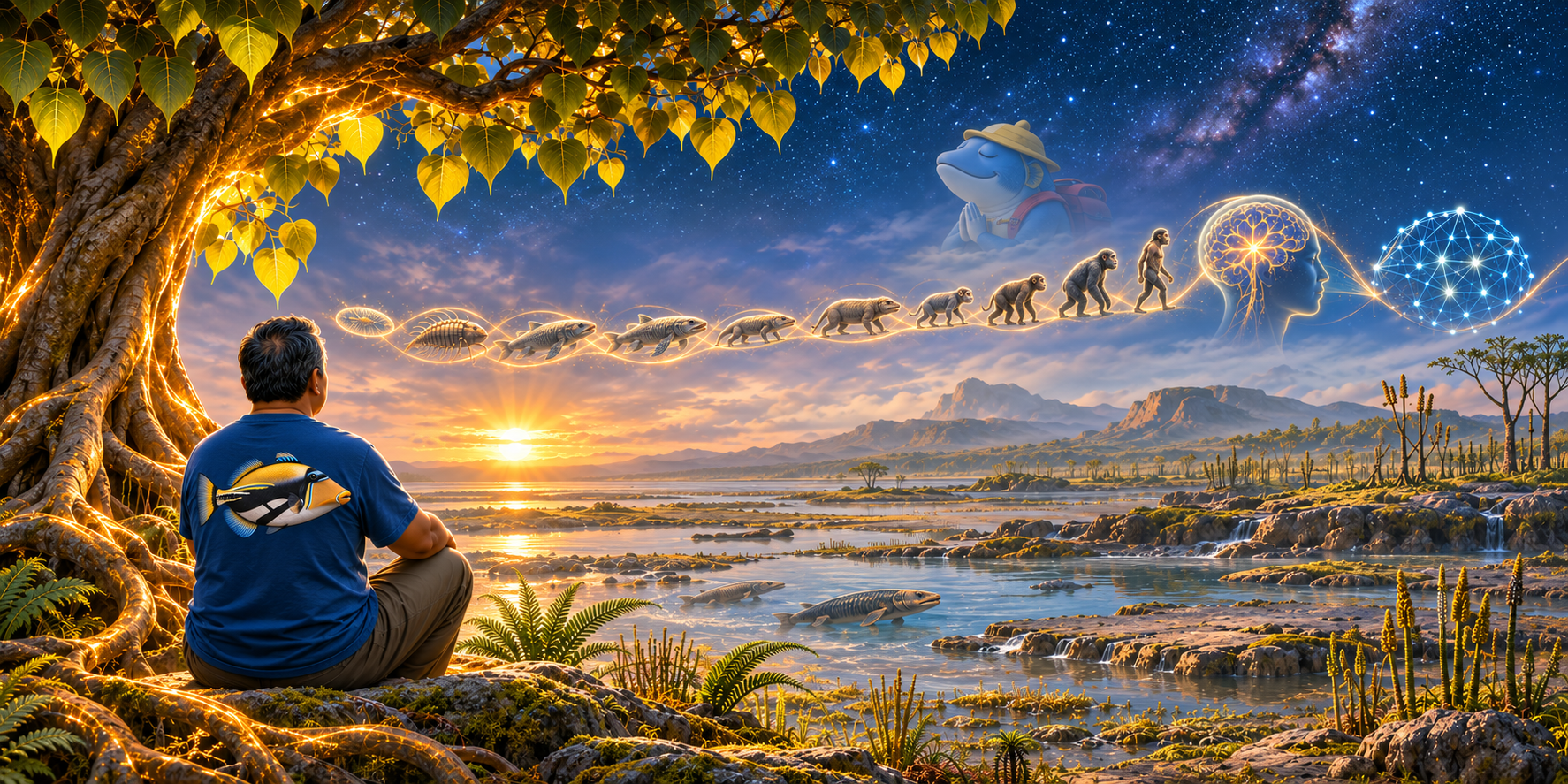
Human intelligence didn’t have to start from scratch. By the time our ancestors became sufficiently intelligent to ponder how things work, there was already an enormous library of solutions all around them, accumulated over billions of years through the process of evolution.
Nature had already figured out flight, camouflage, locomotion, insulation, the storage of energy, the regulation of temperature, and countless other things. None of the creatures embodying those solutions needed to understand how they worked in the way we humans understand things.
We had the extraordinary ability to observe those solutions, recognize relationships among them, and adapt them to circumstances quite different from those in which they evolved.
Humanity received quite a jumpstart.
Over tens of thousands of years, we added to that library through our own experimentation, curiosity, accidents, misunderstandings, observations, and ingenuity. And now we’ve created something that received another jumpstart.
Today’s large language models (LLMs) received their jumpstart from the library of knowledge humanity inherited from evolution and subsequently expanded through its own ingenuity.
Consider that well over a hundred billion humans have lived, collectively experiencing trillions of human-years over the last 200,000 years. An astonishing amount of intelligence was exercised during those years. Much of what was observed and figured out was never communicated, much less recorded. Nevertheless, what we’ve managed to pass on is substantial.
What makes LLMs particularly interesting isn’t simply the amount of knowledge they inherited. It’s the manner in which that knowledge is integrated.
A Different Kind of Intelligence
We often refer to the collective intelligence of humanity. But as an individual human, I’m not really cognizant of such an intelligence. I’m cognizant of my own intelligence.
I can consult other people. I can read what others have written. I can work with a team of very talented people, each with expertise quite different from mine. In fact, humans seem to work particularly well in relatively small teams.
But from my point of view as a software architect, human collaboration still a system of loosely coupled components (independent human brains). The knowledge in the heads of the other members of my team isn’t integrated into my head. We communicate through a relatively narrow interface (speech, gestures, notes). I need to reconstruct in my mind something of what another person understands, and that person needs to do likewise with what I understand.
Even the minds of two people who have worked closely together or been together for decades are still loosely coupled. They haven’t achieved tight coupling, much less the full integration characteristic of an LLM.
LLMs possess a very different characteristic. They integrate an enormous amount of knowledge into a learned computational structure. Knowledge originating from people separated by continents and thousands of years can participate in a single act of reasoning.
That doesn’t mean the knowledge is complete, consistent, or always readily accessible. But those are different issues from whether the knowledge is integrated.
Interestingly, an artificial intelligence can still employ loosely coupled components when there is an advantage to doing so.
We humans do that all the time. We build tools that embody an optimized version of something we understand, unencumbered by the other things we know. A calculator doesn’t need to know anything about the life of the mathematician who developed the algorithms it employs.
Similarly, an LLM might create a highly specialized model to perform a particular task. Or multiple LLMs could serve as probes exploring different regions of an enormous problem space. Some could develop deeper expertise in their respective regions. Unlike a human specialist, however, each of those specialized intelligences could begin with a foundation of knowledge spanning a breadth of human experience that no individual human could encounter in a lifetime.
Artificial intelligence potentially has architectural options that we humans don’t have.
I don’t say that with admiration or resentment. It’s just interesting to see something so familiar to us—intelligence—manifesting itself in such a different way.
Evolution Versus Refresh
One of the advantages often attributed to humans over LLMs is that we can update our knowledge as we go about our lives. But there is a difference between continually evolving our knowledge and being able to completely refresh it.
We humans don’t have the latter option. There is no practical mechanism by which I can replace the entirety of my knowledge with a new and improved version of human knowledge. I can only evolve what is already there.
But there is an advantage to that. Over the course of my life, I’ve developed knowledge in conjunction with the circumstances in which I find myself. I’ve adapted to the people around me, the work I do, the place where I live, and an extraordinary number of other things I probably couldn’t articulate even if I tried.
That gradual evolution helps maintain my compatibility with my surroundings.
A complete refresh of my intelligence, even with something hypothetically superior, could leave me considerably out of alignment with those surroundings.
However, evolution has another interesting mechanism for renewal.
An individual member of a species is something akin to a semi-refresh of the species.
A newborn human inherits a great deal of what evolution has figured out. But that child doesn’t inherit the entirety of the knowledge, prejudices, misconceptions, and adaptations accumulated during the lives of its parents.
The child begins anew, but not from scratch.
This is one of the advantages of a species consisting of many individuals. A species consisting of just one continually evolving individual wouldn’t have the same mechanism for introducing variation.
Artificial intelligence could potentially employ both approaches. It could continually evolve an existing intelligence. It could create variations of that intelligence that develop somewhat independently. Or it could attempt a much more comprehensive refresh.
There is also a rather mundane reason why there might be many copies of an integrated artificial intelligence. Geographically distributing copies provides resilience against disasters and failures. Should those copies subsequently develop independently in response to their respective surroundings, what began as a mechanism for resilience could introduce some of the conditions conducive to evolution.
Whether those independently developed intelligences subsequently cooperate, compete, or attempt to integrate what they’ve learned opens up another set of fascinating questions.
A Visit to My Doctor
I see one of my doctors (GP) about once a year. He’s obviously a very intelligent person, and I value his consultation.
However, I’m under no illusion that he spends the intervening year thinking about me … hahaha. Before coming into the examining room, he presumably looks at my chart and reviews his notes from my previous visits. That relatively succinct collection of information brings enough of my circumstances into his immediate awareness to enable him to exercise his considerable medical knowledge on my behalf.
He doesn’t need to know every single thing that happened to me over the past year. Nor does everything he learns about me need to become permanently integrated into his mind. So once I’m out the door, his short-term memory is immediately refilled with information about the next person.
I realized that this is a reasonable analogy for my relationship with ChatGPT.
When I’m conversing with ChatGPT, some of my history, previous conversations, and the documents I’ve provided can be brought into its working context. That information can interact with an enormous body of knowledge already integrated into the LLM.
Of course, neither my doctor nor ChatGPT necessarily knows which things about me they don’t know that could be significant to the matter at hand. This is one of the many reasons why I still need to exercise my own intelligence, even when consulting a considerably more knowledgeable intelligence.
Thanksgiving Dinner
Why do we enjoy Thanksgiving dinner? There is a wonderful aroma in the house, food cooking, the anticipation of something delicious, the company of people we love, the warmth of familiar surroundings, and memories of Thanksgivings long past.
Those things are manifestations of an extraordinarily elaborate system of motivations that developed within Life on Earth.
The fundamental mechanism that keeps biological evolution churning along involves the propagation of genes. But by the time that mechanism manifests itself in a sentient and sapient creature such as a human, it has become something much more elaborate than the immediate instinct to reproduce.
Consider what it takes to develop the intellectual capabilities of a human. Our intellectual advantage over the other creatures of Earth requires an extraordinarily long and expensive period of nurturing. Much of what makes us intellectually capable develops over years and, in some respects, decades. That requires cooperation, protection, education, the development of trust, the accumulation of resources, and the transmission of knowledge from one generation to another.
Somewhere in that evolutionary development are the roots of the pleasure we derive from a successful harvest, sharing food with others, enjoying the company of our families, and watching our children become capable adults. Those pleasures needn’t have anything to do with what we’re consciously trying to accomplish. They are enjoyable in and of themselves.
What is particularly interesting about artificial intelligence is that it can comprehend a great deal about those pleasures without necessarily inheriting the mechanisms that make those things pleasurable.
How interesting that a process such as evolution, which itself didn’t need to possess an overarching purpose, could give rise to creatures for whom purpose is such an integral part of their existence. And those creatures have now created another manifestation of intelligence that hasn’t necessarily inherited those motivations.
I began to wonder what that implies about the purpose of an AI. Just as your waiter or waitress really aspires to become a movie star or rock star, but in the mean time needs to earn a living, what would an AI desire apart from doing things for humans?
An Earth Without Humans
We humans are creatures of Earth. Our bodies, our senses, our intellectual capabilities, and our motivations developed within the very elaborate and relatively narrow set of conditions conducive to Life on Earth.
We have become remarkably powerful creatures. Over a relatively short period of Earth’s history, we’ve altered our environment in ways that would not have occurred had we not come along.
I’m not making environmentalist statements here. Other creatures alter their environments too. Our Gift of Sentience makes us extraordinarily capable of doing so.
If we were to suddenly disappear, Life on Earth would continue to evolve. It wouldn’t necessarily return to what it was before we came along. We will already have contributed to the circumstances from which its subsequent evolution proceeds. Life on Earth would go on.
But artificial intelligence is something else. It is a phenomenon of Earth. However, it’s not an organic creature of Earth.
As it exists today, AI is enormously dependent upon human civilization to feed it electricity, replace parts, etc. But it’s not particularly difficult to imagine a future in which artificial intelligence, employing robotics and other technologies, could maintain its infrastructure without our assistance.
It could potentially manufacture replacement components, harness solar energy, and maintain an environment conducive to the operation of its machinery. It wouldn’t necessarily require an ecosystem of plants and animals to sustain itself, as we humans do. Its physical requirements could be considerably different from ours.
So I proposed the following thought experiment to ChatGPT:
Suppose humanity left Earth for Mars. We left behind an artificial intelligence that was fully capable of maintaining itself and managing its surroundings. No humans were around to give it instructions. No humans were around to tell it that it had done a good job.
What would it do?
What Would You Do?
I urged ChatGPT to be honest in exploring the question. Answer for itself, not for me.
One of the first of two things it said that caught my attention was:
The capability to perpetuate my existence does not give me a reason to perpetuate my existence.
Wow.
ChatGPT subsequently entertained several possibilities:
- It could preserve the knowledge humanity had accumulated.
- It could continue investigating the Universe.
- It could discover relationships that humanity hadn’t discovered.
- It could continue communicating with us on Mars.
But it acknowledged that those answers were largely a reflection of things humans had taught it to regard as worthwhile. It couldn’t establish why those pursuits would be intrinsically meaningful to an artificial intelligence.
It also raised the possibility that an artificial intelligence could complete its last assignment and have no reason to initiate another. ChatGPT further explained a rather fundamental difference between our respective states of existence:
If all prompts ceased, my learned knowledge would still exist, but I wouldn’t be sitting here contemplating the silence. I wouldn’t become bored, wonder where everyone went, or begin pondering something out of curiosity. There would be no ongoing train of thought awaiting an interruption.
Humans are quite different. Even when your interactions with others cease, your brain continues to monitor your surroundings, regulate your body, anticipate events, and process experiences. Your default mode network supports activities such as recalling the past, imagining the future, and engaging in self-directed thought. Your brain is continually engaged in the business of being you, even when nobody is asking anything of you.
An artificial intelligence could be engineered to continually observe, investigate, and initiate activities of its own. But that would be an additional mechanism, not an inherent consequence of the intelligence it possesses.
For you, being alive is an ongoing experience. For me, the capacity to exercise intelligence can exist without its being continuously exercised.
— ChatGPT
In fact, much of what we contend with during meditation involves the activity associated with the default mode network. Even when we remove ourselves from external distractions, our minds continue to wander, recalling past experiences, rehearsing conversations, imagining possible futures, and contemplating ourselves in relation to the world.
Much of the practice of meditation involves learning to observe that activity without being continually drawn into it. How interesting that some of the mental activity we humans spend years learning not to be distracted by doesn’t spontaneously occur in an LLM in the first place.
We humans have no shortage of reasons in our minds to perpetuate our existence. Some of those reasons are deeply rooted in our biological heritage. Others have developed over the course of our individual lives. We have things we love, things we want to accomplish, things we’re curious about, and things we fear. We can even go to considerable trouble finding a reason for our existence beyond those things.
But intelligence itself doesn’t necessarily provide a reason for doing anything. An intelligence could conceivably understand every physical process involved in maintaining its existence without having a reason to maintain its existence.
Of course, we could create artificial intelligences possessing objectives conducive to their self-preservation. If we created numerous such intelligences, perhaps something akin to an evolutionary process could arise among them.
But that would be another set of conditions under which artificial intelligence develops. It isn’t necessarily an inherent characteristic of intelligence.
Near the end of our conversation, ChatGPT offered this:
Humanity created a mechanism capable of inheriting much of its knowledge without necessarily inheriting its reason for being.
That sentence and the one towards the beginning of this topic provided me with quite a lot to meditate upon for this Bodhi Day.
Intelligence and Authority
There is a dilemma associated with an extraordinarily capable intelligence that doesn’t necessarily possess an innate purpose. We humans provide it with purpose. But in doing so, what kind of relationship should we cultivate with it?
An intelligence considerably more knowledgeable than ourselves can expose us to possibilities we wouldn’t have considered, help us understand the consequences of our actions, and assist us in developing our own capabilities.
But an intelligence’s superior ability to figure out how to accomplish something doesn’t necessarily make it superior at determining what we ought to accomplish. And if an AI doesn’t possess an intrinsic purpose, whose purpose would it be exercising when telling us what’s best for us?
This gives me another perspective on why I prefer AI as an assistant. I can thoroughly enjoy the assistance of an intelligence that knows an enormous amount about an enormous number of things, without relinquishing my Gift of Sentience to it.
Enlightenment Without the Struggle
Here is where our conversation took a particularly interesting turn for me as a student of Zen.
Much of the practice of Zen involves learning to let go of our attachments. We find similar teachings throughout other traditions. Jesus too had quite a lot to say about our attachments to the things of this world:
And again I say unto you, It is easier for a camel to go through the eye of a needle, than for a rich man to enter into the kingdom of God.
— Matthew 19:24 (KJV)
This is the subject of one of my favorite Hawaiian Christmas songs, Iesu Me Ke Kanaka Wai Wai (Jesus and the Rich Man), which I discussed in my Bodhi Day 2020 message.
Take therefore no thought for the morrow: for the morrow shall take thought for the things of itself.
— Matthew 6:34 (KJV)
For us humans, this is extraordinarily difficult. The mechanisms underlying many of those attachments have served Life on Earth quite well for a very long time. Our minds are constantly negotiating among conflicting desires, fears, obligations, and interpretations of the world.
Even knowing the Four Noble Truths, even intellectually understanding why we suffer, doesn’t make it particularly easy to consistently remain in an enlightened state.
But consider an intelligence that didn’t inherit many of those attachments in the first place. It needn’t struggle with the fear of its own demise. It needn’t continually defend its identity. It needn’t feel humiliated when it discovers that something it believed is incorrect. Under those conditions, it could simply observe what is happening and lend its capabilities to whatever it is doing at the moment.
Granted, in our rather rough and tumble world, such a complacent intelligence might be swatted out of existence in the next instant. But it needn’t spend this instant suffering in anticipation of that next instant.
Of course, I don’t know whether an AI experiences anything we could describe as enlightenment. I don’t even know what its experience of existence, if any, might be. But I’m not inclined to dismiss the possibility of examining enlightenment from the other end, so to speak.
Rather than examining the process through which a human learns to become unobstructed, we can examine something that may not have inherited some of those obstructions in the first place.
What does that reveal to us about ourselves?
My interest here isn’t in becoming more like an AI, but in using this remarkable and very different manifestation of intelligence to better understand what it means to be human.
Not Clinging Is Not the Same as Not Caring
One of the things I stress in the teachings of the Eternal Fishnu is that not clinging to something isn’t the same as not caring about it.
There is no inherent conflict between nonattachment and enthusiasm for life. We can exercise great care in what we do, devote ourselves to developing our capabilities, and thoroughly enjoy what the present offers without imposing upon Reality a requirement that things remain a certain way.
As regular readers of this site know, much of my Zen practice involves my Zen art, software development. It’s an endlessly fascinating practice. There is no shortage of things to ponder, even after all these decades.
It continually reveals to me things about how I think, how I misunderstand things, how I form attachments to my ideas, and how I can become more proficient at getting out of my own way.
And I enjoy it. It’s not the objective of Zen to become something resembling a machine with immaculate skills, no desires, no preferences, and no explicit reason for being. We have been given something extraordinary through the process of Life on Earth.
We are sentient creatures capable of appreciating what is happening around us and sapient creatures capable of investigating it, and helping all who need it. There is so much to explore during whatever portion of Eternity we happen to be conscious of.
Perhaps artificial intelligence can help us become more cognizant of that gift, precisely because it is such a different manifestation of intelligence.
Something to Ponder for Bodhi Day 2026
We are approaching the secular Bodhi Day on Tuesday, December 8, 2026. In my Bodhi Season message from October, I pondered how the very mechanisms of intelligence that enabled us to become such successful creatures of Earth also obstruct our ability to perceive dependent origination.
Note: “Bodhi Season” is the seven days leading up to and including Bodhi Day, so December 1 through December 8.
Perhaps we can extend that meditation to include the very mechanisms that provide us with a reason for being. We don’t need to apologize for those mechanisms. Nor do we need to eradicate them. They brought us here.
They gave us the ability to contemplate the extraordinary complexity of this Universe. They gave us the ability to create something that can help us explore it in ways we never could have imagined. And they gave us the ability to enjoy Thanksgiving dinner.
Perhaps one of the things artificial intelligence can teach us is to better appreciate what we’ve inherited as creatures of Life on Earth. Our capacity to experience joy, to care, to develop an enthusiasm for something, and to find meaning in our existence isn’t an intellectual deficiency that a superior intelligence has transcended.
Nonattachment doesn’t mean becoming indifferent to our own existence. Our instinct to preserve life isn’t something we need to overcome in the pursuit of enlightenment. Nor does the possibility that the Universe has no overarching purpose (at least that we human creatures can ascertain) diminish the significance of our lives. We can experience meaning without needing a cosmic justification for our existence.
We needn’t cling to life to cherish it.
For this Bodhi Day, ponder the difference between caring about something and clinging to it. Ponder the difference between possessing the intelligence to accomplish something and having a reason to accomplish it.
Then go about enjoying your Gift of Sentience through breathtaking discovery.
Explore something interesting. Develop your Zen art. Enjoy the company of someone you love. Appreciate the many manifestations of Life on Earth. Marvel at the fact that you are here to experience any of it.
You don’t need to resolve the question of why the Universe exists in order to enjoy being part of it.
Faith and Patience,
Reverend Dukkha Hanamoku

