
It has been about 2500 years since the basis of Buddhism was pointed at. Dependent origination. Emptiness. The claim that what we take to be a thing does not carry, inside itself, what makes it that thing.
But people still struggle to get it. Society isn’t filled with enlightened Buddhas. It’s hard when the underlying idea goes something like this:
When this exists, that comes to be. With the arising of this, that arises. When this does not exist, that does not come to be. With the cessation of this, that ceases.
Those are not difficult sentences—in fact, rather “duh” at face value. It gets repeated, nodded at, and folded into “everything is connected” and “change is constant”, therefore “everything is impermanent”. Then everyone goes back from embracing complexity to the comfort of thinking in simple cause and effect—flipping switches to turn a light on and off and placing full blame on that poor straw that broke the camel’s back.
So, my click-bait title was going to be: Finally Understand Why Sustained Enlightenment is so Elusive?
We’ve all had flashes of enlightenment, usually when we’re on vacation, like after a successful Bodhi Day retreat. Sometimes, counter-intuitively in the midst of an extremely stressful time. But they quickly disintegrates into the hustle of your “normal” daily life.
But the teaching is not the obstacle. Our symbolic minds, our Gift of Sentience, are the reason enlightenment is so elusive. While it is the reason humanity has more than thrived on Earth, it is also the reason we cannot see the world in its fully connected, impermanent glory.
Our symbolic mind gives us another version of thinking Earth is flat because it sure does look flat within the small area we’re standing in. I’ll give you this version from the Eternal Fishnu, which is not about standing on a limited plot of land but existing within a short span of time, like our human lives:
Something seems real because it changes slower than the process of our minds.
Reductionist science, deductive logic, recipes, algorithms, procedures—we have built much of civilization by doubling down on the same symbolic trick—carve the world into parts, name them, then arrange them into sequences we can manipulate.
What do humanity and a hurricane have in common? Both are phenomena that arose under the marvelously intricate conditions that enable Life on Earth. And not just what happens on that delicate film on the surface of Earth. It’s a vast dependency on the Earth’s internal and surface geology, obviously the sun, and Jupiter that attracts and absorbs many free-floating objects that won’t end up hitting us. In fact all the bodies in the solar system, even the galaxy, and other galaxies have now and in the past an effect on where this glob of molecules we call Earth ended up such that the conditions for humanity and hurricanes can arise.
So here is the TL;DR in secular, sequential terms:
- The Universe is one all-encompassing process. What we call individual things are relatively persistent configurations within it.
- Life on Earth arose within an unusually delicate, yet remarkably robust and resilient, set of conditions.
- Living things evolve under pressures from their environment and from one another. Competition—especially the continuing contest between predator and prey—rewards better ways of recognizing and responding to danger and opportunity.
- Intelligence depends on recognizing useful distinctions. Lion versus grass. Food versus poison. Danger versus opportunity. This requires drawing temporary boundaries around parts of the world.
- Humans took this much further through symbolic thinking. We can give those recognized things names, remember them, manipulate them in our minds, and arrange them into sequences: if I do this, then that should happen.
- Symbolic thinking works spectacularly well within limited places and timeframes because most surrounding conditions remain stable enough for us to ignore them. We notice what changed and treat everything else as background.
- Stated Simply: he cost is that our useful simplification begins to look like reality itself. We see separate things and chains of cause and effect where the Universe is really a shifting web of conditions. Dependent origination is the reminder of what our symbolic minds left out.
The Good Reason
The world does not arrive as things and steps. It arrives as a vast field of shifting conditions, most of them changing at once, most of them not waiting for us to finish what we are doing. Trees are growing while markets move while cells divide while someone across the table decides whether to fold. A dry forest can be one spark away from a fire and, at the same moment, one rainstorm away from not being. A relationship can be one sentence away from breaking and one apology away from not breaking. The openings sit there together. Some complete. Some expire as the condition window shifts.
The reality of Life of Earth is that it’s a whirlwind of almost recurring phenomena. By “almost recurring”, I mean that there are lives that are born, grow, reproduce, and go back to the Earth. It’s a numbers game of species-wide capabilities whirling around the capability sets of other species. And by “lives” I don’t mean just critters. I mean things like the ever-reconfiguring continents, hurricanes, tides, seasons, and el Ninos.
But all the creatures of Earth are not each just leaves passively going with the flow. All living things have some level of intelligence and agency. That can range from simply an paramecium darting away from the appearance of a big shadow, to measuring several factors to decide when to drop or grow their leaves, to lions effectively outsmarting and/or outperforming gazelles and gazelles effectively countering the adapted capabilities of the lions.
Intelligence requires us to isolate phenomena in order to recognize and react to danger or opportunities to move in a favorable way. Lions must be able to distinguish elephants from gazelles and gazelles must be able to distinguish lions from grass.
The human species took symbolic thinking to the “S-tier”. We draw a box around fields of arisen phenomena. We give the boxes a name. Tree. River. Enemy. Friend. Self. House. Cause. We stop looking at most of what is outside the box, because most of it is not the part we can use. Then we arrange the boxes into a sequence. First this. Then this. Then this. A hunt. A recipe. A plan. A throw. A program.
That is not a dumbed-down picture of the world. It is a survival mechanism. A predator does not need every molecule in the forest. It needs something more like: if I move this way now, the prey may move that way. The prey is running the opposite model. Over a very long time, the animals that could imagine an outcome and a short sequence toward it had descendants. We are those descendants. Toolmaking, agriculture, engineering, and most of what we call civilization are that trick scaled up.
It works because we took advantage of a hack to the system. Within a small place and a short time, most of the field of conditions stays inside our tolerances. The electricity is usually on. The oxygen is usually there. The mountain usually has not moved. The other person’s body usually still has weight, joints, and a habit of resisting a pull. We act on the little piece that changed, and the rest of the machine does what it was already prepared to do.
Language uses the same economy. At dinner I can say “hand me that,” and almost nothing required to understand the sentence is in the sentence. Who you are, who I am, which object, what a hand is for, why you would move it toward me: all of that travels in the background. We speak the delta. We assume the field.
This is our superpower. Sequences, names, interfaces, recipes. A desired configuration of the world, and a sequence of moves that might get us there. I make a living at a version of it. People ask questions all day where my answer should begin with “it depends”, but what they want instead “just one answer”: “Just give me the fish, you can teach me to fish later.”
What the Hack Hides
The cost is that the symbolic thinking hack becomes the world.
Once the box has a name, it starts to look as if the name were in the thing. The river looks like a river. The self looks like a self. The last event in the log looks like the cause of the next event. We know, if asked, that the water is changing. We say so. Then we walk outside and see the river. The intellectual copy does not replace the perception. The perception is the older tool.
Think again on: Something seems real because it changes slower than the process of our minds.
A weed in the garden does not seem eternal, because I can watch most of its life inside a small part of mine–a mere season of a year. A mountain does. Not because the mountain is holding still. Because I am badly placed to watch it. Close up it is cracking, shedding, wetting, drying, and moving with the ground under it. From a life, it is a state. So we treat it as a thing. The conditions for matter are even more stable than the conditions for life, and the conditions for life are stable enough, for now, that people can act as if both were a trusty background of assumptions. Then our little sequence looks like it did all the work.
Cause and effect is this compression at its most successful. I flip the switch and the light comes on. I water the plant and it improves. I let go of the cup and it falls. Wonderful models, until the power is out, or the soil is already soaked, or we are not on Earth. Then we remember that the switch never did much by itself. Generation, lines, transformers, wiring, a bulb, a voltage, all of that was simply there. We had stopped seeing it because it had not changed. We noticed the delta and named it the cause.
What I approached from a data science and Buddhist angle, Western philosopher, J. L. Mackie approached from analytic philosophy, in a 1965 paper called Causes and Conditions. He called the thing we pick out an “INUS” condition: an Insufficient but Non-redundant part of an Unnecessary but Sufficient condition. (Yes, I know …) An electrical short “causes” a house fire only together with fuel, oxygen, heat, and the absence of someone putting it out. A candle and a curtain would have done it by another route. We don’t call the oxygen the cause. The oxygen was already in the room.
Mackie wasn’t a Buddhist. I hadn’t read him when I got to the same idea. What he named is the trick. Attention focuses on the new symbol and leaves the field in the background.
Statistics is the same confession, written as a percentage. When A happens, B happens 93 percent of the time. The other seven percent is sometimes noise. Very often it is a condition we decided not to model, which was not in its usual state. The arrow A → B was a useful lie of omission. Variance is the shadow of the omitted field.
Zen Memes
There is an old Zen picture of snow on a bamboo leaf. Snow gathers. The leaf holds. One more flake lands, the leaf bends, the snow slides, the bamboo rises. People point at the last flake as the cause—the tipping point.
The picture is a good meme. It is not the basis. The last flake is only the delta we are equipped to see. The leaf’s strength, the angle, the load already there, the shape of the snow, a little wind, a little warmth turning flakes to water: those were the field. They do not photograph as well as a flake. So the flake gets the name. It’s like the poor straw that gets the blame for breaking the camel’s back—it wasn’t just its fault.
I saw the same deletion in a poker log I worked on for a machine learning project years ago. The history reads: raise, call, fold, raise. Event, event, event. That is not what a player meets. A player meets a state. Who is still in, what is in the pot, what stacks remain, what round it is, what is showing, what has already been committed, and a great deal more that no model keeps. An action does not produce the next action. It changes the conditions under which the next player will act. A good player is often trying to curate those conditions. He still does not control the act. The other player brings cards, fear, fatigue, and a read he may have wrong. The log stores the symbol and throws away the state.
The notion of Kuzushi in the judo world is the same deletion in the body. A beginner thinks: I pull, he loses balance, I throw him. At any instant there is stance, grip, momentum, hips, and, above all, what uke (the one being thrown) does back. Pull him forward and he may pull back, and the throw you intended is gone and another one is sitting there. Tori does not contain the throw. Uke does not contain the throw. It arises from the configuration. The body can feel that. The story told afterward is still a chain, because a chain is what we know how to store.
Helpful hint:
The uke (the one being thrown) usually learns more than the tori (the one doing the throwing).
Under all of these conditions is a universe full of things that did not happen. A state is not a queue for the next event. It is a crowd of partly met conditions. A bluff that no one attempts. A spark that doesn’t fall. A sentence that doesn’t get said. The opening has a lifetime. Then the field moves, and that particular event is no longer available. We remember the event that fired. We do not remember the ones whose conditions expired. A symbol has to be of something. An almost-happening often never becomes a thing we can name.
The most relevant example is this. Enlightenment itself is a condition waiting to be met, not an isolated event like a light switch turned on. Siddhartha Gautama didn’t awaken because he meditated under the Bodhi Tree for days. It was the last piece that made decades of suffering and immense effort searching, experiencing. Part of the awakening was also to accept and embrace a long journey still ahead.
Why Emptiness Doesn’t Stick
Here is a key question, a counter-factual that opens big doors to insight in any endeavor:
What isn’t empty?
The short answer: Everything is empty.
A weed in the garden seems empty, because we can watch it die. A mountain seems less empty. A number seems not empty at all. A melody copied from one instrument to another. The weights of a language model, saved exactly. The relations among them do not rust. An abstract triangle does not age.
That sorting is the symbol machine again. We had equated emptiness with falling apart. So whatever changes slower than we do gets promoted to a real thing, and whatever does not seem to change at all gets promoted to an essence.
That is the wrong cut. Empty does not mean nonexistent, and it does not mean temporary. It means the thing does not contain, from its own side, what makes it what it is. The weights are a language model only relative to an architecture, an order, a tokenizer, and a process that uses them. A triangle is the relation of sides, vertices, and angles. There is no nugget of “triangleness” under the relation. Take the relation away and the name is all that is left, which is to say nothing.
Nāgārjuna’s word for what we keep assigning is svabhāva, a nature the thing would have from its own side. We don’t adopt that assignment as a theory. It is the default delivery of a symbolic mind. The box is drawn, the name is given, and the name starts to look like it was found rather than made.
So the basis arrives, and the same mind files it. “Everything is connected” is a symbol. “Nothing really matters” is a symbol. “This too shall pass” is a symbol, and a misleading one, because the notion of a triangle is not waiting to pass. The teaching described a world with no seams of that kind. The listener stored a sentence. The sentence can be repeated for 2500 years without the perception ever being replaced, because the perception is how a human being gets through a day.
Is that All?
Enlightenment doesn’t help if we can’t pay our bills, loved ones are seriously ill, or there’s war brewing. It doesn’t help much to not cling—or at least not clinging to things that really shouldn’t be clung to. It doesn’t help that much to be “Stoic about it”—focusing on what we can change and not what we cannot change.
But it can help to realize that what your brain computes isn’t necessarily as things really are. It’s our symbolic minds that cling to things they’ve come to know. Impermanence is the profound nature of the Universe. But what has faded is still intimately tied to what is assembling. A galaxy millions of light years away was once, billions of years ago, close enough to us where any deviation from what it did would probably result in this Earth never forming.
It’s comforting to know that in an empty universe there are no eternally enduring configurations. Conditions shift, and with them the field of what is possible.
The Three Zen Stories
It’s comforting to know that you can train your mind to focus on what you have control over. The Three Zen stories underlying the Teachings of the Eternal Fishnu teach us to:
- house models of the world in your mind that evolve along with the real world – The Empty Cup
- have 100% acceptance of what is – Is That So?
- stay on the long path of these skills – The Man with the Bag
The first two are required to evolve towards the conditions you need. The third is very important. Enlightenment doesn’t mean you reached the finish line. It’s just a milestone on the path—but now maybe things might be more interesting and less scary.
Remember, symbolic thinking is the basis for our Gift of Sentience. It lets us operate on possible worlds in our heads before trying to create one of them in the physical world.
We Are Not Supposed to Stop Being Symbolic Thinkers
None of this is a criticism of humans as symbolic thinkers. It is the basis for our Gift of Sentience. We are not going to stop. We should not stop. The sequence is how we cook, build, treat a wound, and cross a street. Cause and effect is one of the best compressions we have, precisely because the field is often stable enough for the problem in front of us. Dependent origination does not make the light switch a lie. It says what had to be left out for the light switch to be a model.
The elusiveness is not that the basis is hidden. It is that seeing without the boxes would be a bad way to survive, and we are the survivors. The real world, in the sense the teaching means, is the field before the seam: conditions met, an event emitted, conditions changed, other events not emitted because their conditions were never completed, all of it moving in parallel. We cannot live in that view. We dip in, if we are lucky, and then we pick up the name again, because someone asked us to pass the salt.
On hikes out in solitude, where there is distance from all that pulls at you, it can seem obvious. In the hustle of our daily lives, it does not. The hustle is the symbolic layer doing the job it was built for. It is the world that makes us cling to things—security, money, reputation—in order to prosper. Buddhism has been trying to say what that layer is not. It still eludes practically everyone, for a good reason.
So what do we do?
Let’s start with good ol’ cloud gazing—laying on the grass watching the clouds go by. Nothing else. The clouds move along in some direction, constantly changing in shape. Periodically, an abstract form of something familiar appears—a dog, couch, your grandmother’s profile.
That is the simplest example of switching between the reality of the universe and symbolic thinking.
A step up from cloud gazing is life hundreds of years ago when there was ample space between things and thoughts. At its foundation, it’s not that different from cloud gazing—just more complicated. Instead of just clouds streaming by, landscapes, critters, and a person periodically floats by. We notice aspects of the landscape (like a stream to cross), critters we might want to avoid, and people we need to address. It’s much more than the occasional shape in the clouds, but it still fits within the parameters of our consciousness and brain.
Modern life is several steps up from life hundreds of years ago. Communication across the world is almost instantaneous. At work, there are often many competitors posing “existential threats” to our company that we must counter. On the way to work, we cross many streets, negotiate traffic with thousands of others—each a potential hazardous situation. That’s well beyond the parameters of our consciousness and brain.
Most of what you think you need, you don’t really need. You’ll go all-in on something only to end up losing. I’m saying even modern life is still within the comfortable parameters of our consciousness and brain if you learn to let go of:
- What is out of your control—thank you Stoics. Believe me, this cuts out most things.
- What you’ve been marketed to believe you need. Marketing is more science than art today—it’s not the old-fashioned ad campaigns of McMann and Tate that appealed to the needs of people.
- The shrapnel from the activity of others who are leashed to greed.
- The past and the future, and bravely seize the present moment—again, thank you, Stoics.
When all that is left is all that really matters, your symbolic thinking in this complex Universe is indeed the Gift of Sentience. And what is left is plenty! If more people did that, there’s more room for healthy, invigorating competition from a large pool, instead of manipulation by few.
Bodhi Day 2026 – And a Bit of Catching Up
It’s about two months from Bodhi Day–the Secular Bodhi Day on Tuesday, December 8, 2026. This blog begins the Bodhi Season for me, which continues through to the Lunar Bodhi Day on January 15, 2027.
I’ve been quite busy at my work. Another book was published, about a dozen long blogs on my work site. So the BodhiDay.org and Fishnu.org sites have been quiet since last January.
Interestingly, my work over this year has focused much on “knowledge graphs”, which is really tripling down on symbolic thinking … hahaha.
But it’s fine. One benefit of working on AI for a Zen practitioner is it offers a compelling mirror of ourselves. Albeit a very blurry and messy mirror, like if we took a piece of crumbled aluminum foil and looked at our reflection.
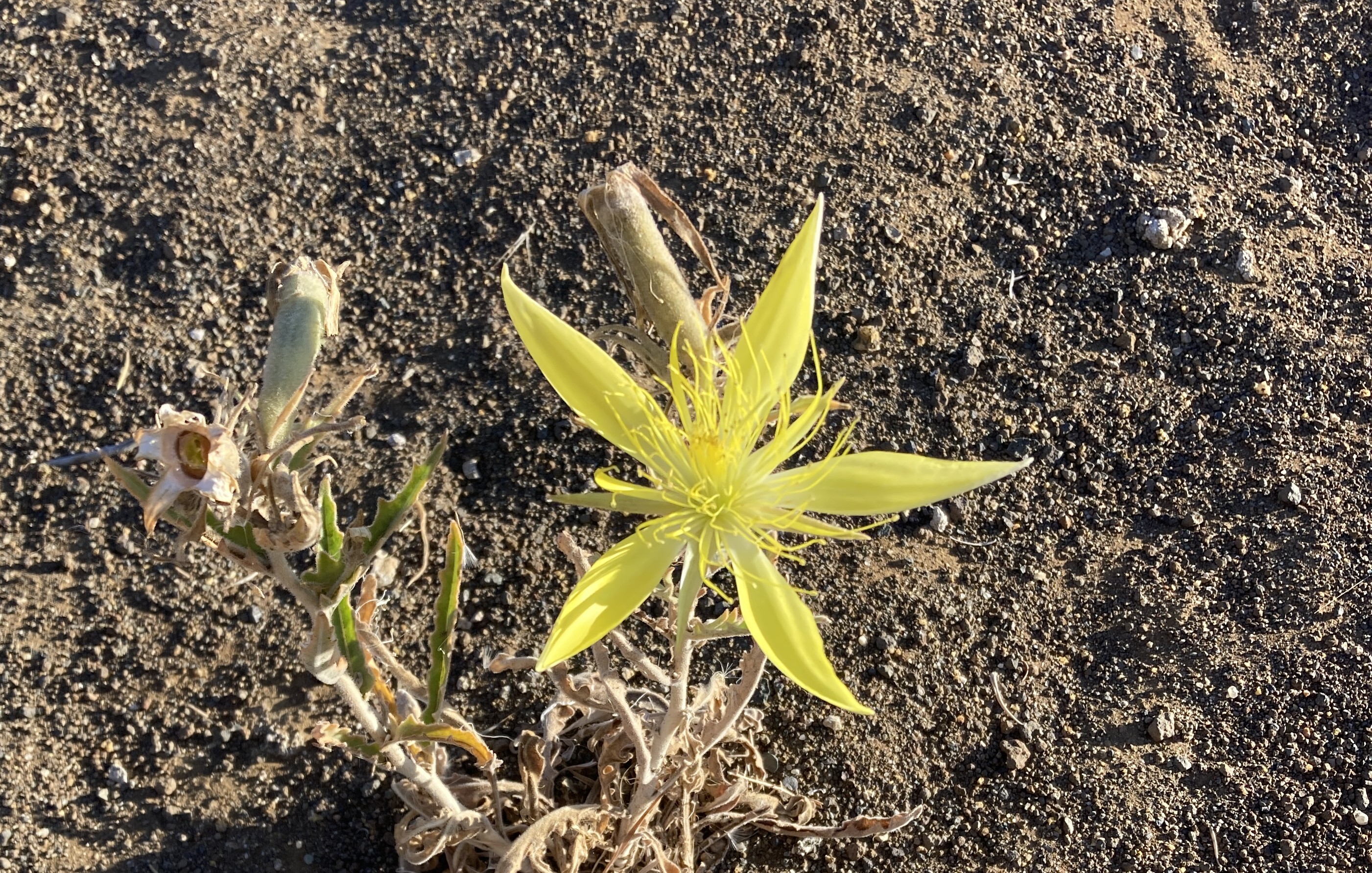
Fun fact: The yellow flower in the “feature image” of this blog is called a giant blazingstar. I took the photo two days ago on a hike with Mrs. Hanamoku. It’s about five inches across and very strange—a flower that just seemed to have popped out of the ground, like a mushroom. We never saw one. So, I thought it made an appropriate image for a blog on enlightenment.
Faith and Patience,
Reverend Dukkha Hanamoku

