
After 22 years, my kāhili ginger finally bloomed! But before continuing, there is an arc of a Bodhi Day message in here—it’s not just about one of my gardening experiences.
I brought home a small kāhili ginger (hedychium gardnerianum) rhizome from Hilo Hattie back in 2003, during a visit to my mom and other family on Oahu. It was one of those little souvenir plants—nothing special, just a rhizome of a couple inches. For twenty-two years it grew strong and green but never bloomed.
Boise is not kind to tropicals. Although the summers and winters aren’t anywhere near the worst on Earth, the high desert summers can be too hot and dry, but more importantly the winters do freeze the ground solid. Each spring (around mid-May) I would carry it outside with the ti plants (Mr. Ti, which I bought at the same time I bought the kāhili ginger), setting it beneath an ornamental plum tree where it was partially shaded and well watered by the almost daily sprinklers. Each fall (early October), I’d move it (and Mr. Ti) back into the cold garage, where it would never freeze, but wasn’t exactly warm. Its growing season of less than five months wasn’t long enough.
It lived its life in a pot, endlessly repotted as it grew, but never rewarded me with flowers. A few years ago (I think 2023), a “bracted spike” (a cluster from which multiple flowers bloom) formed just before Fall. I took the ginger into the house that year, but the bud just shriveled and died. I thought the heater in the house made the air too dry, and there isn’t much sun in a single place in the house.
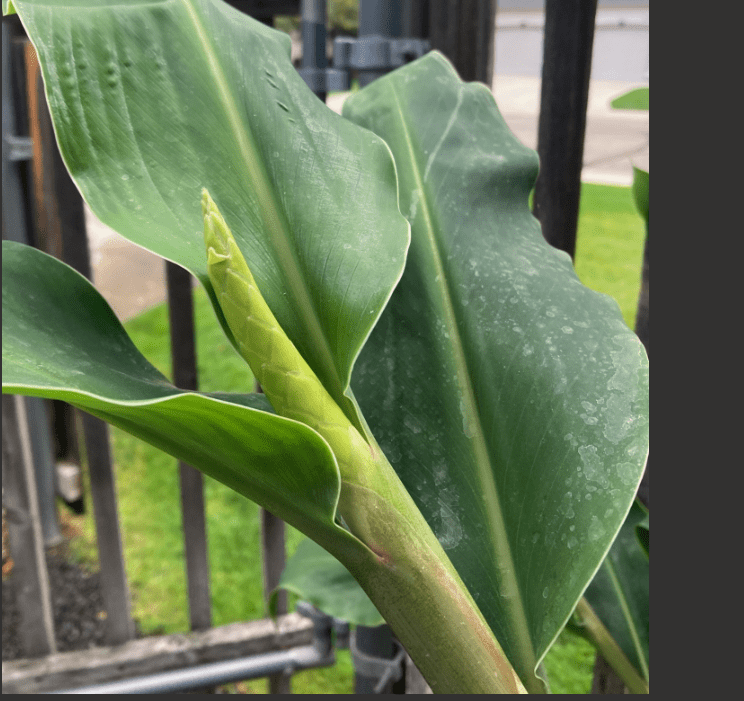
This year, the plant burst out of its pot and was too large for its old place beneath the tree, so I moved it to the only space left where it would get full sun for a few hours each day—which I thought was a bad thing. At this point, I really didn’t care since I kind of gave up on it. But I didn’t give up. I misted it several times every day it to cool the leaves, fertilized it almost every other day with a weak solution of organic fertilizer (which I knew wouldn’t be as harsh as the chemical ones). I didn’t really expect anything, but I didn’t want my 22 year old plant to die.
Then, around mid-August, a bracted spike appeared. I wasn’t that excited yet since that happened before with no luck. But I continued the daily regimen of care, and a month or so later (September 23, 2025) the green shell-like bracts opened and out came the first yellow flower—after over two decades of trying.
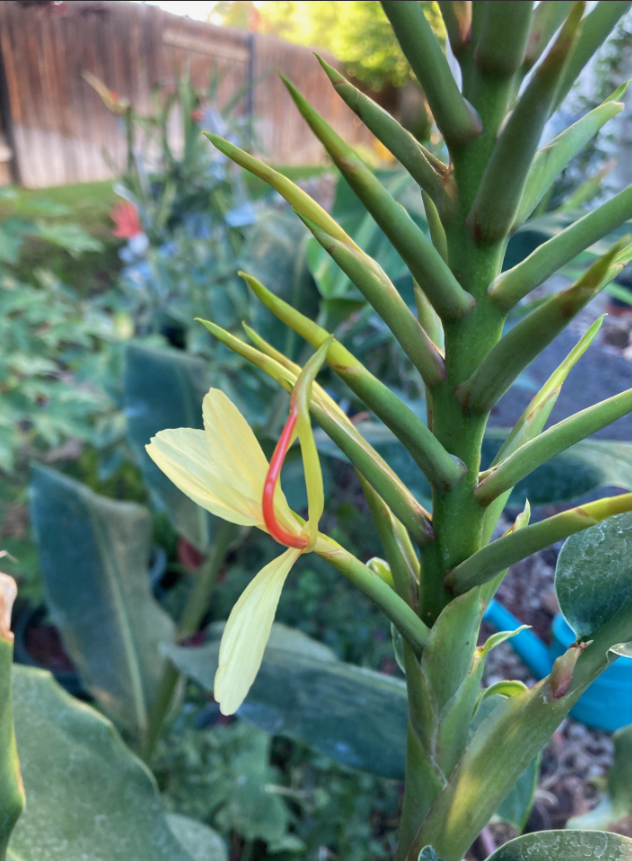
I was already happy with that one flower. But over the next week, the other buds bloomed until we had a full-blown bloom!
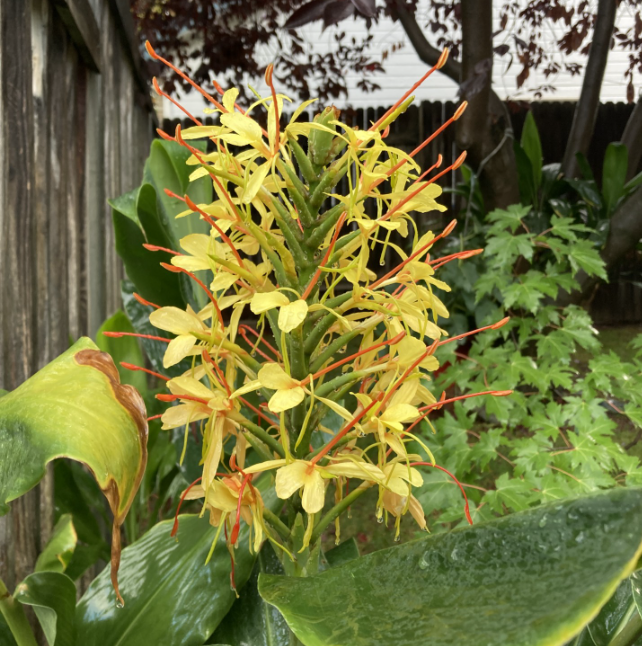
The yellow flowers did surprise me since I always thought it was a white ginger (hedychium coronarium). I’m pretty sure that’s what the label said. The greenery of the white ginger and kāhili was almost indistinguishable. But I’m glad it was a kāhili ginger since the full bloom is much more elaborate. Both are highly fragrant and used to make perfume (more so the white ginger).
I’m not exactly sure about why it bloomed this time. It suspect that assuming the desert sun was too much for it and shading it under a tree (where it still had partial sun) was wrong. In shielding it from Boise’s desert light, I may have kept it from its own fulfillment. Maybe even bursting out of its pot was beneficial as it might have made the dirt well-drained while still being very moist. I don’t know. As Bob Ross would say, it’s all the bunch of happy accidents.
It reminds me how growth sometimes waits until we stop trying so hard to control it—when we finally let the world’s harshness test what we’ve nurtured too carefully.
The Little Prince
Mrs. Hanamoku’s favorite book is The Little Prince by Antoine de Saint-Exupéry. It’s one of those rare books that, as C.S. Lewis and others have suggested, deserves to be read a few times in life—once in youth, again in adulthood, and once more in old age. One of its most enduring lessons is found in the story of the rose the Little Prince cared for.
The Little Prince tends to a single rose that grows on his tiny planet (the small world of a child). She’s vain, proud, and sometimes ungrateful, yet he waters her each day, shelters her under a glass dome, and guards her from the wind and the caterpillars.
When he finally leaves his planet to explore the stars, at some point he encounters a vast garden of roses, thousands of them, all like the one he cared for. He felt betrayed. His rose had told him she was unique, but here were thousands—beautiful, fragrant, and nearly identical. The realization that his beloved rose isn’t physically unique was more than flustering. All that work, all that affection, for one among many.
But later, guided by a wise fox, he comes to understand what makes his rose different. It isn’t her appearance or fragrance—it’s the time and devotion he invested in her. She became his rose because of the care he gave her—the watering, the listening, the small daily acts of attention. That intimacy transformed an ordinary flower into something irreplaceable. Meaning doesn’t arise from rarity alone; it comes from relationship, from the quiet accumulation of moments in which we choose to care.
Discovering My Precious Kāhili Ginger is a Weed in Hawaii
In all the excitement of the kāhili ginger bloom this year, I researched more about it. To my amazement, I discovered it’s considered an invasive species in Hawaii ! A weed! I was shocked to find kāhili ginger on that list since non-native plants now make up over 90% of Hawaii’s vegetation—the clear majority. Hawaii’s fertile volcanic soil, consistent rainfall, and mild temperatures mean just about anything grows exceptionally well there, which is why even iconic coconuts (and other species like kukui nuts and breadfruit) aren’t native but were brought by early Polynesian voyagers.
I know how the Little Prince felt about discovering his rose wasn’t special.
In the damp forests of Hawaii or the Himalayas (obviously not the Mt. Everest parts), it does grow like a weed, covering entire hillsides without anyone’s help. But here in the high desert of Boise, coaxed along in a cold but not freezing garage at night, carried outside on sunny afternoons, and watched over like a friend at the edge of winter, it becomes something else entirely. It’s my rose—one that blooms only because I cared for it enough to make a small pocket of the tropics in a high desert. Its value isn’t in its rarity but in the shared act of survival.
Boise, Idaho, sits in USDA Zone 7a, where the winter lows can dip to 0 to 5 °F. Kāhili ginger, by contrast, is suited to Zones 8–11—the kind of frost-free climates found in the eastern Himalayas where it originated, Hawaii, or other tropical places. In Boise, a single freeze would blacken its leaves and kill the rhizomes outright if left outdoors. It can only survive as a container plant, nursed indoors through the cold months, coaxed into bloom with the same care a rose gets under glass.
On Oahu, though, it’s Heaven for kāhili gingers. The island’s windward slopes sit solidly in Zones 11–12, never freezing and perpetually on the humid side. Those same conditions that force us to coddle a ginger in Boise let it grow unchecked there. Rhizomes crawl through rain-soaked soil, and birds scatter its seeds across valleys; without frost to reset the landscape, it overruns native forests. The same plant that’s a fragile exotic in Idaho becomes a forest weed in Hawaii —a reminder that “invasive” and “cherished” are often just reflections of climate and context.
The Lesson of the Fox
When the Little Prince meets back with the fox after seeing the thousands of roses , the fox teaches him that meaning comes from relationship—from “taming”, in the fox’s terms. That is, forming ties through time, attention, and ritual:
- Taming makes someone unique. There may be thousands of roses, but your rose is special because of the time you spent with her.
- Rituals matter. Showing up at the same time, sitting a little closer each day—these small practices weave trust.
- See with the heart. The fox’s “secret”: “One sees clearly only with the heart. What is essential is invisible to the eyes.”
- Responsibility follows love. Once you’ve formed a bond, “You become responsible, forever, for what you have tamed.”
The Little Prince realizes his rose is irreplaceable not by appearance, but by the care that bound them. Of course, the lesson applies not just to roses and kāhili ginger in Boise.
My Kāhili ginger Didn’t Stop at 1
The day after the full bloom (October 2, 2025), the temperatures were going to dip into the 40s °F. I learned that the prolonged exposure to those temperatures would trigger a dormant state, at the least. That meant the flowers might be damaged. But there were also three more fronds with bracted spikes.
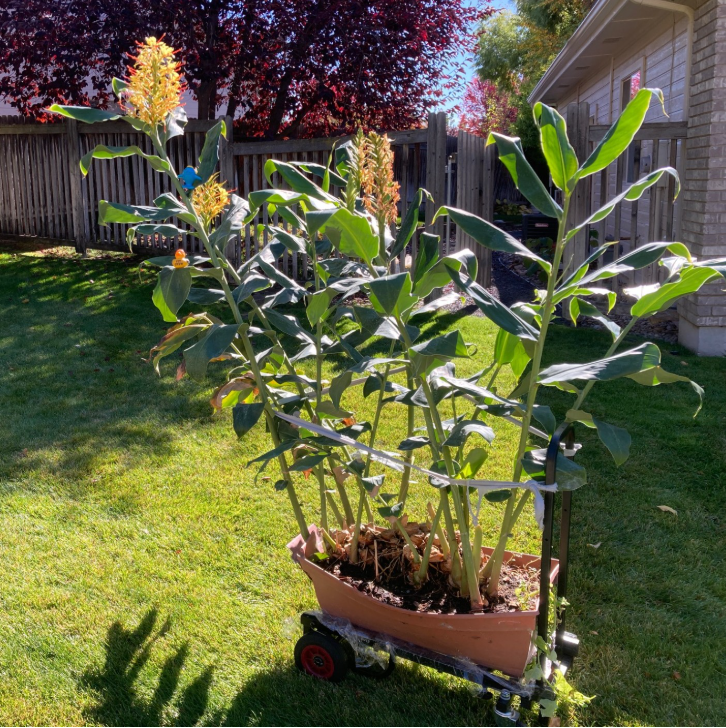
As I mentioned, I was happy just to see one bud bloom. But I wanted to challenge myself to get the others to bloom. So I lifted the plant in the huge pot onto a dolly. I would take it into the garage at night and wheel it out when the temperature hits 60 °F and it’s at least somewhat sunny.
Over the next two weeks, I did just that. The bracted spikes continued to grow. By last week Wednesday (October 15, 2025), one of the bracted spikes was on the verge of blooming.
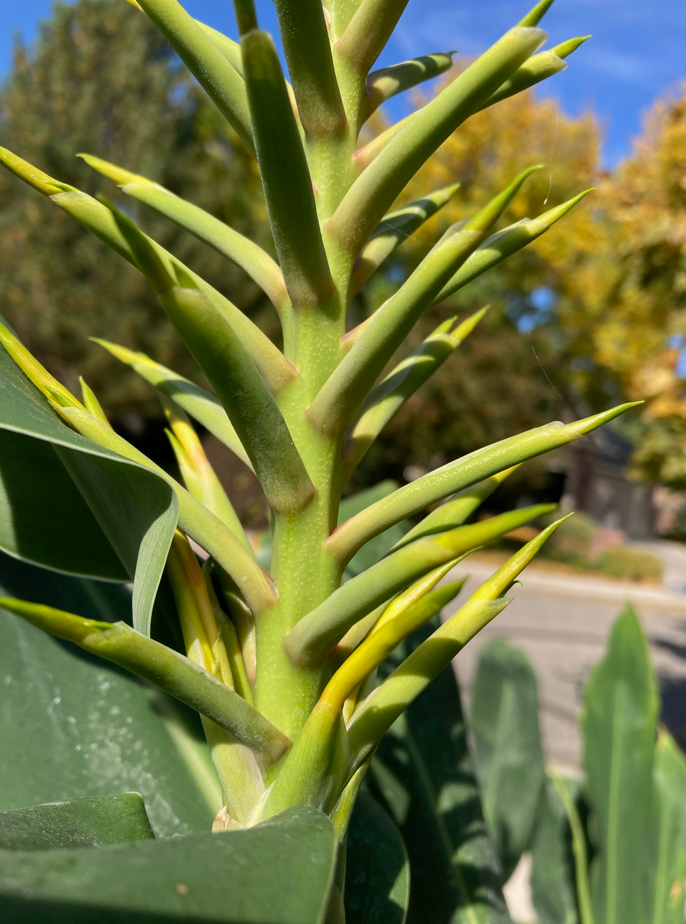
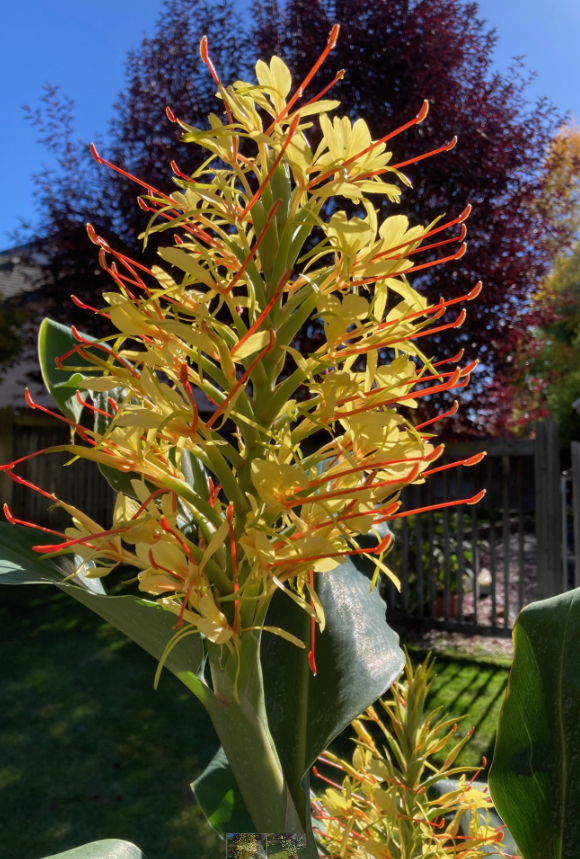
By yesterday (October 19, 2025), the bracted spike was in full bloom. It was much faster than the first one.
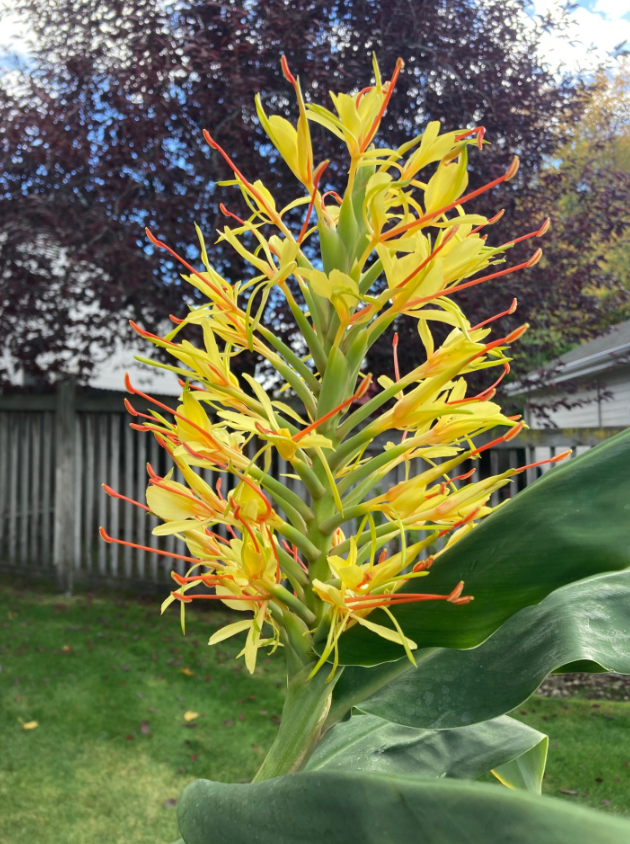
We’re not done yet because the 3rd one (towards the bottom of the photo below) is halfway through! You can see the 1st blooms, now dried up, towards the left side. The maple tree in the background with the Fall colors proves it’s not in Hawaii :)
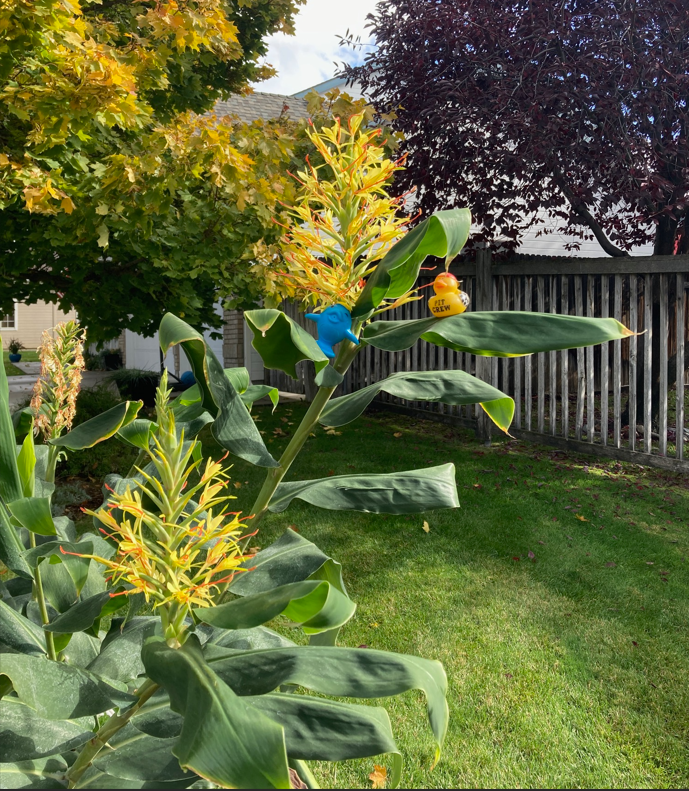
Here’s a picture from today on the dolly.
Conclusion
Gardening is just a minor hobby of mine, behind Zen and guitar. I do have other plants that I over-winter in the garage and care for on a daily basis during the warm season. I even try something new each year—this year it was “broom corn” (sorghum from which brooms and whisks can be made).
For the kāhili ginger, I could have tried harder to solve the problem for all these years—tried more sun, bought a solar lamp for the over-wintering, etc. But as long as it looked lush and healthy (which it usually did), I was satisfied that it was all I could do.
As I mentioned earlier, the initial bloom of the kāhili ginger was a happy accident. It was the potential of the subsequent blooms where we had the excitement that drew more of our attention and we applied more creative force (putting it on a dolly and dragging into the garage at night) towards getting into getting the other bracted spikes to bloom.
To my friends in India, Happy Diwali!! This year, we’re celebrating with you through my kāhili ginger, which ends in a few days as the high temperature looks like it will dip below 50 °F for good—too cold to roll it out into the yard for sun. It does sparkle like the lights of Diwali. Doesn’t it?
Faith and Patience,
Reverend Dukkha Hanamoku
 Bodhi Day