
What has recently been coined “AI Slop” is the endless churn of “heavily AI-assisted content” (my nice, Zen-appropriate term for AI Slop). I ran into the phenomenon of “AI Slop” while trying to figure out why the views on this site cut in half a few months ago (since July 2025). The concept isn’t new. Bots have plagued comments of all social media sites for many years. But AI Slop expands that phenomenon well beyond annoyance. Here are a few very good recent videos that describe AI Slop:
- AI Slop is Killing Our Channel — Kurzgesagt
- AI-Generated Work Slop is Costing Companies Millions in Lost Productivity — Nobody Special Finance
- I’m Sorry…This New Artist Completely Sucks — Rick Beato
- AI Was Supposed to Cure Cancer – We Got This Instead – Vanessa Wingårdh
The problem isn’t just quality of the heavily AI-assisted content. It’s actually quite good as long as there isn’t an expectation of deep quality. At best, it’s just repackaging of what is already well-known. For example, those “top 15 most …” or “the strangest 15 things about x”.
Like bot commenters on X and other social media, it drowns the voice of real people—especially those who create original content from their original ideas. Heavily AI-assisted content piles up at least a magnitude faster than human-created material, which means the very sources that trained the LLMs in the first place risk being buried by their synthetic descendants. For one type of AI Slop, AI-Generated summaries at the top of Google and Bing pages that answer your query, the people who actually did the work upon which the AI-generated summary is based, don’t even get the click.
For most content creators, who create original work that pushes the envelope, AI slop can be financially devastating. For content consumers, this means that the quality of original work might start to drop off the face of the Earth. When the AI giants say they are “running out of training data”—well, this kind of kills the golden goose.
Figure 1 shows an example of how easy it is to create heavily AI-generated content, which I posed to Grok.
Note: I include the date/time of the snapshots in this blog since it will undoubtedly be different soon after the time of writing.
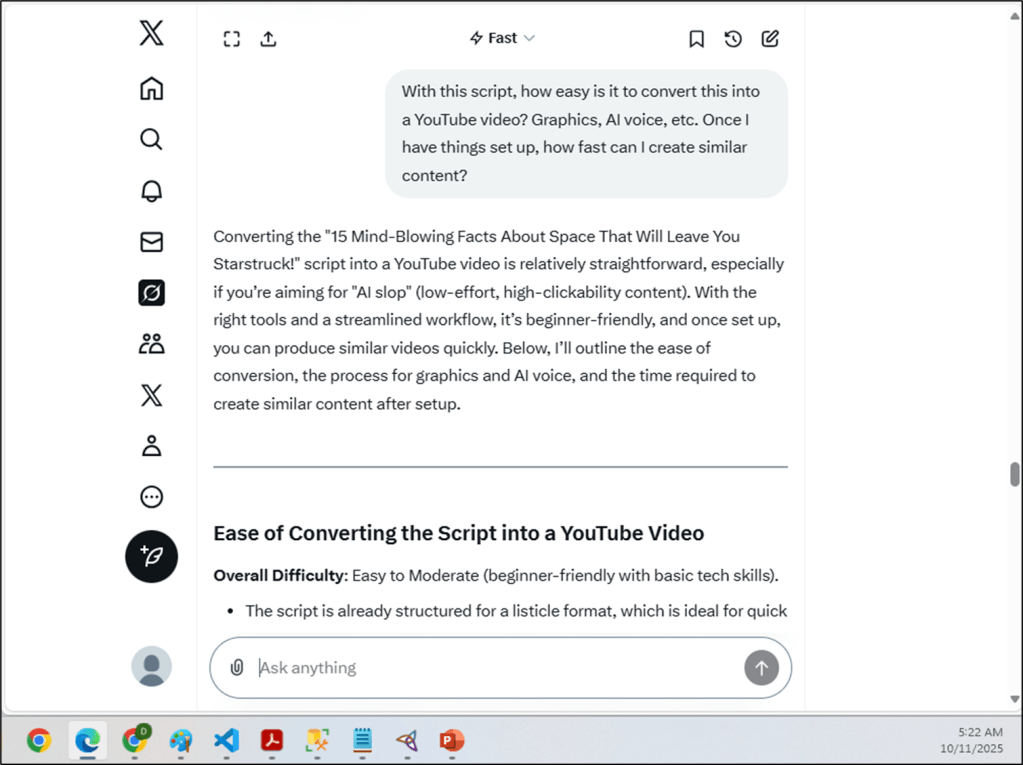
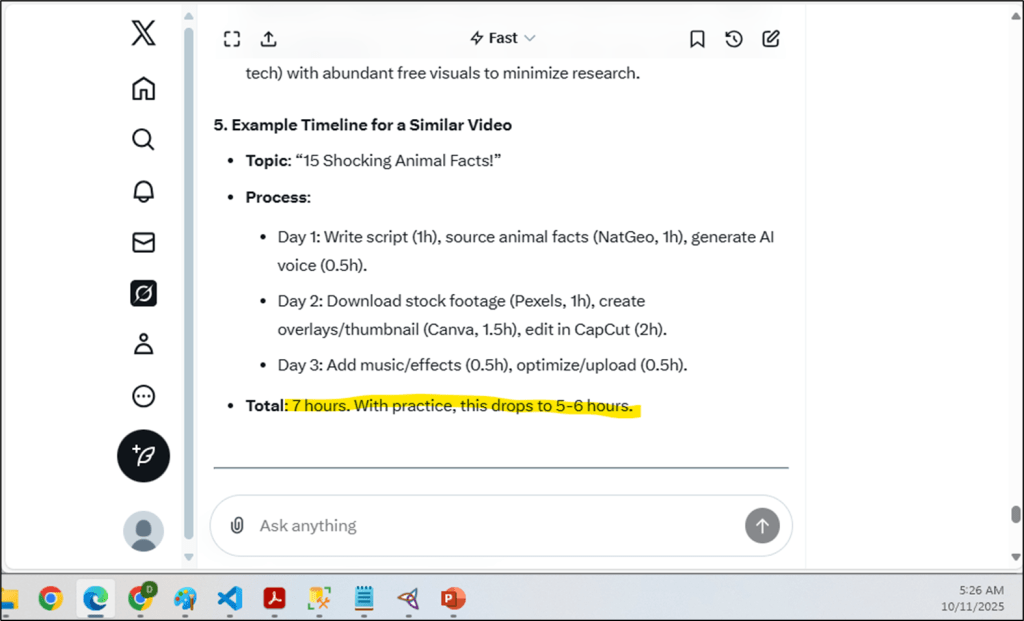
Figure 2 shows the key element of Grok’s answer shown from Figure 1. With the process set up and well-practiced, one could generate a well-produced video pretty much every day, 7 hours. I suspect that Grok is being very politely conservative towards people. It’s hard to imagine it won’t take too much to spew out the stuff in seconds and by the thousands.
I’ve heard that most content creators who put out original, researched content spend about 40 to 100 hours to produce a 10-20 minute video. That aligns my experience for the longer blogs (25 minutes and over to read) I’ve written for my professional site. The blogs on this site are much shorter, but it still takes me a full weekend to write one.
However, I rarely ever write any blogs (on this site or my professional site) until the story is pretty much laid out in my head and it’s primarily a matter of writing at that point. I don’t include the countless hours of my professional work (software as a Zen path) that is the source of the inspiration for what I write on this blog, the countless hours of pondering during my walks and hikes, nor the experiments.
The Impact to Content Creators
For content creators, this is the equivalent of Wal Mart and Amazon for the local stores and Starbucks for the local coffee shop. In my case, this site and the sister site, fishnu.org, has never generated a cent of income. I’m a software developer and that’s how I make a living. So the risk of my needing to abandon writing BodhiDay.org articles to find an alternate way of making a living is a non-issue.
But what about all the other content creators from various mediums who put together original material that extends our corpus of knowledge? Remember, at least for now, AI is trained off that material and (at least for now) doesn’t really add much more inventive value on its own compared to the human experts. Until AI becomes becomes smarter than the smartest of us in each domain, who will continue to push the boundaries?
My concern is that my writing is intended to help people on their Zen path. I suppose, someday AI might be much better at it than I or other similar content creators. Perhaps it already is. But AI or no AI, the teachings of the Eternal Fishnu are eternally valid for this domain of reality.
AI-Generated Search Page Summaries
For the past couple of years, my research queries have migrated from traditional web search such as Google and Bing to prompting ChatGPT, Grok, or Gemini. The results are usually very good, even providing the links I’d be looking for in a search page anyway. So Google and Microsoft know that is the rapidly growing trend, so why not just put the AI-generated summaries at the top of search pages?
For complicated or complex questions, I won’t take the AI’s word at face value, but I do think the sources that are cited represent a reasonably reliable start.
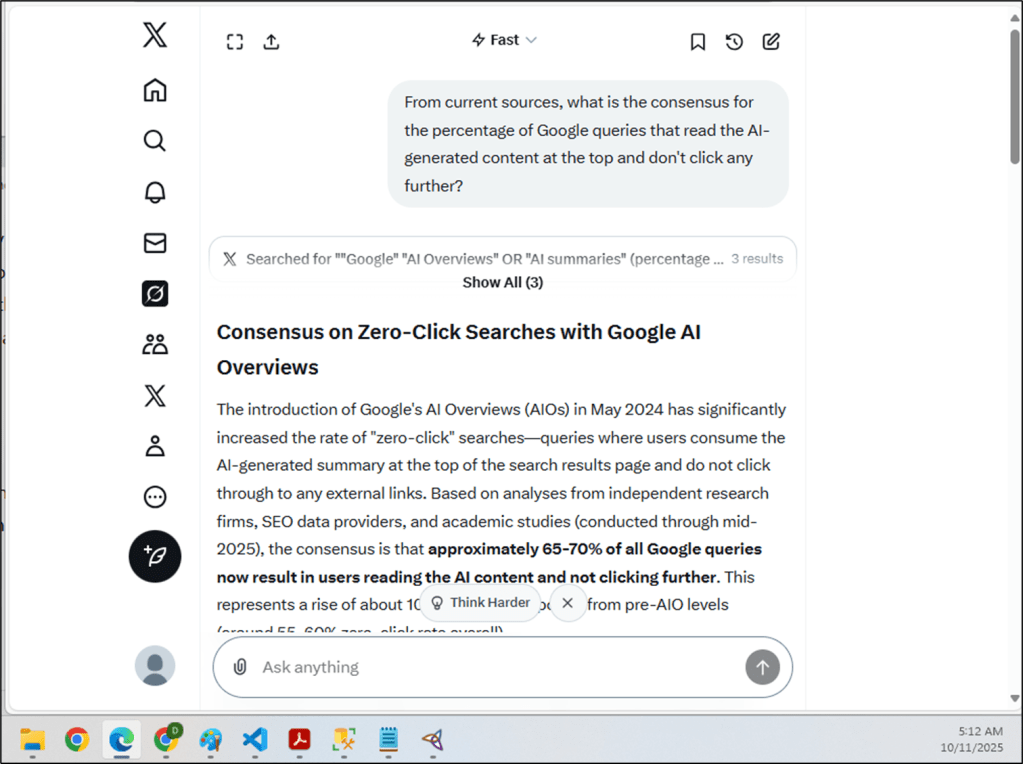
For this site, about 90% of the views are to the home page. It seems to be from people who are looking up this strange, exotic holiday called “Bodhi Day”. But because Google (and Bing) now place an AI-generated blurb summarizing Bodhi Day at the top of the page, most don’t need to go any further. From what I gather from other sources who are experiencing the same thing, that’s about 70% of queries—which more than accounts for my 50% view drop-off these past few months.
Figure 3 shows exactly what I’m talking about. I personally calculated the date of the next Lunar Bodhi Day and updated the main page with that information, since at the time, there did not seem to be a reference. Although Google does list bodhiday.org as a reference, apparently 70% of users will not need to click on my site. For those 70%, the mega-entity Google benefits from my work, while I miss an earned opportunity to expand my reach.
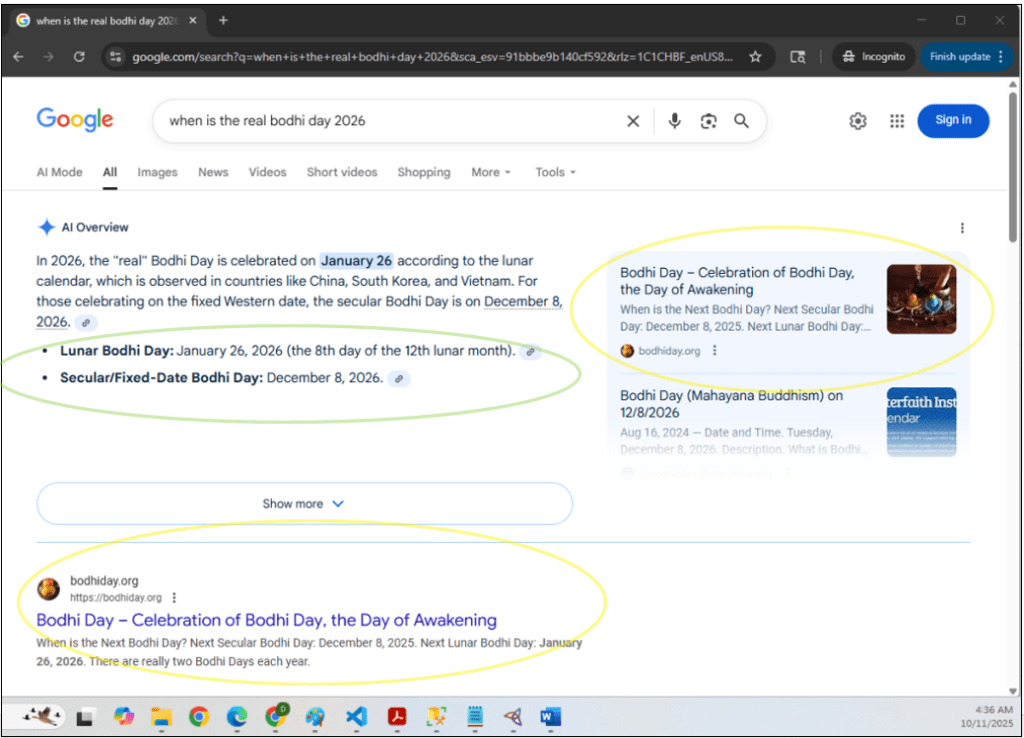
In this case, the answer isn’t straight-forward like it is for when is Thanksgiving or Christmas. There are actually two Bodhi Days—the one I call the secular one, which is always on December 8, and the “real” one I call the Lunar Bodhi day, which is one the 8th day of the 12th month of the lunar calendar year.
Both dates are listed by Gemini in Figure 3. In this case, bodhiday.org appears to be the primary reference as well as occupying the top link slot in this case.
The site has grown steadily over its eight year history—pretty much tripling year over year for the first four years (2018 through 2021), and slowing down to about 50% to 25% year over the past three years (2022 through 2024). Keep in mind though, that it started from just a few hundred hits in 2018, so this is still a very tiny site. But this year, views are down about 25%, year-to-date over last year at this time.
Figure 4 shows confirmation from Grok on that 70% figure.
My “Black Friday”
Roughly 80% of the hits to this site are on December 8, the secular Bodhi Day—it’s my “Black Friday”. About 90% are between the larger timeframe of the first Monday after Thanksgiving and the Lunar Bodhi Day, which mostly occurs in January. So only 10% of traffic comes from outside of the 10-month period outside of mid-November through mid-January.
For the past two years, bodhiday.org is in the #1 or #2 (if #2, mostly behind Wikipedia) for the terms along the lines of “bodhi day” and “what is bodhi day”. I learned during a stint at a large e-commerce site (not the one you’re thinking about) that if you’re not on the first page, you pretty much don’t exist.
Figure 5 shows a snapshot I took showing how bodhiday.org is #1 (for now) but it’s pushed down the page very much by the AI-generated answer and the “People also ask” part.
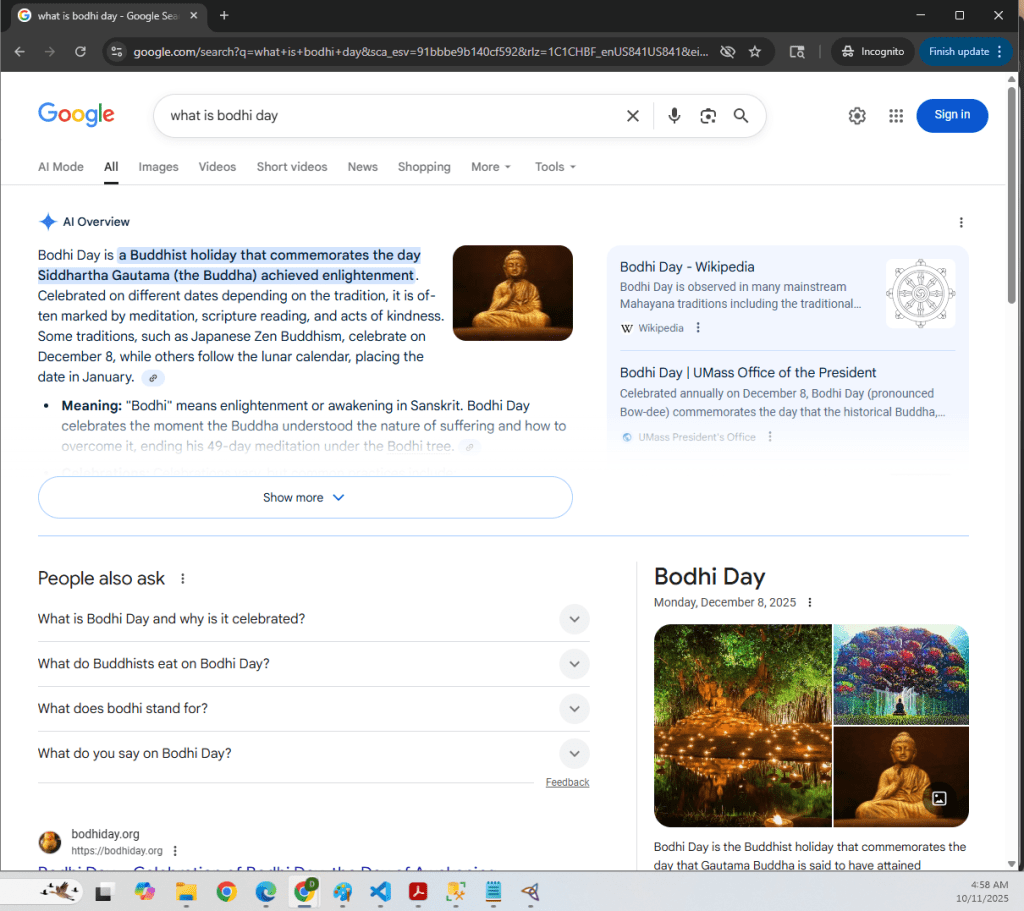
This question, “What is Bodhi Day?” will favor an “authoritative” answer since the answer is more than a simple fact. I suspect there might be some credibility problem with trusting a the information from a site that appears to feature a plastic blue fish and rubber ducky over Wikipedia. In this case, Gemini (Google’s AI) has a disconnect with the Google search engine since it decided to place Wikipedia as its top reference, although bodhi.org is the top referenced site.
Next to when or what is Bodhi Day, the page with the most hits is the one about the rice and milk dish the Buddha ate on the day of his enlightenment. Presumably, people wish to make it.
Figure 6 shows the AI-generated response at the top, which pushed my page down.
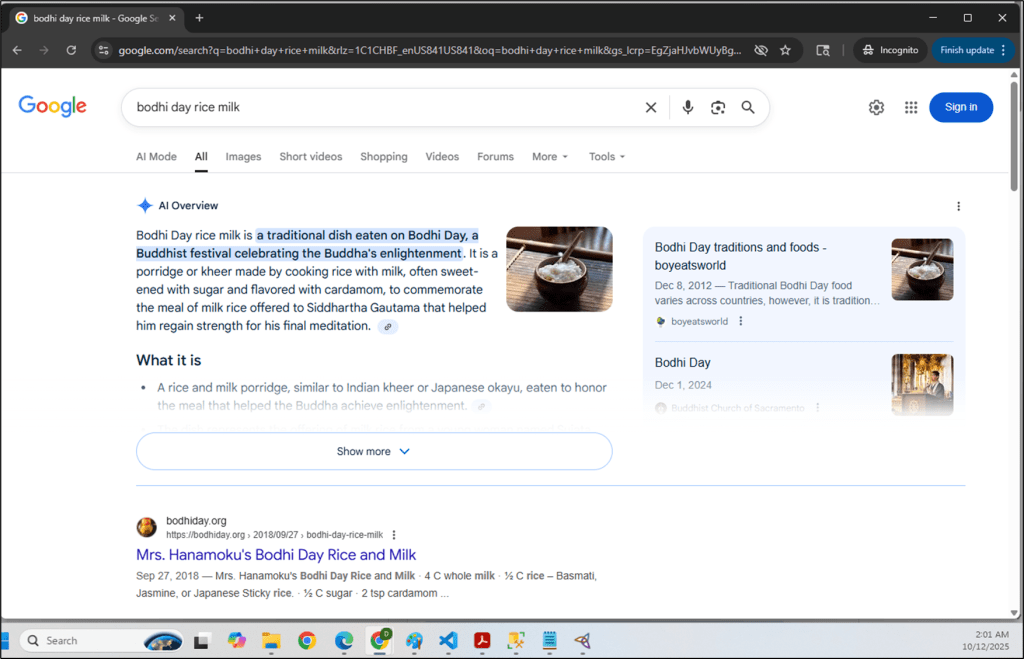
It’s still the top link for “bodhi day rice milk”, but apparently, it doesn’t list my page as a referenced site. Instead, it went with the recipe page from boyeatsworld.com. This example also shows that there is a disconnect between Gemini and the Google search engine. I suppose Gemini reasons that boyeatsworld.com is more authoritative about food recipes than the blue plastic fish site and rubber ducky site.
BTW, the 50% or so reduction in views since around July applies to my professional blog site as well.
What Does This Have to do with Zen?
We came to the end of the maintained trail a year ago. The notion of AI Slop is certainly one of the very peculiar phenomenon to have emerged on the unmaintained part of the trail.
How much more sense did it make to aspire to being a chess champion before Deep Blue defeated the world champion (grandmaster) Garry Kasparov in May 1997? People still play chess and chess grandmasters are still admired for their brilliance.
The day I graduated from high school, the only career advice I ever had was that I could work at the pineapple fields, which fortunately was well on its way out by the 1980s. So I got a job at a hardware store. I also began karate lessons around that time. I now had some money earned from my illustrious job, and needed something meaningful to pursue—that wasn’t high school 2.0 at the community college, which I figured I could do that after a reprieve from what I experienced as mind-numbing school.
A few weeks into karate, after a training session, the chief instructor (Shihan) took me to his favorite soda shop down the street and told me:
You can lose all your money, friends, even family. But once you lose your spirit, you lose.
I’m actually paraphrasing through his very heavy Japanese accent and broken English. It was easy to see that I lost the trail. The difference from most others who could see it is that he did something about it.
Anyway, I think it was the only real piece of advice I’d ever received up to that time. It’s hard to imagine losing all those things—except for the money part since we didn’t have any—but I realized I didn’t have much control over the extenuating circumstances that might lead to that. However, I do own my spirit. One of the prime insights of the Stoics—Marcus Aurelius meets Miyamoto Musashi.
Over the next few years (the 1980s) while I still lived in Hawaii, I did indeed got to know a few people from Vietnam who experienced just that. But in one generation, their kids were in Stanford and Harvard. It happens to this day it still happens to many people around the world. Much of the circumstances are beyond their control, but many honor their lost family and friends by vigorously exerting their spirit in this world.
The day after Shihan’s advice, I acted on it. Long story short (it’s actually a pretty fun story), driven by the relentless spirit that was reawakened in me, I somehow landed a programming job and vigorously fought until six months later, barely 18 years old, I was the “go to programmer”.
I haven’t looked back, even though the rug pulled out from under me several times. I wrote about those times back in 2019, when I commemorated 40 years, when I realized the rug was about to be pulled again. Each time, that same spirit awoke, knowing it leveled the playing field for all of us standing on that same rug. It was the opportunity for that spirit to shine so brightly through all dimensions of space and time that should there actually be a God, multi-dimensional entities, or advanced aliens, it will be noticed.
All this talk of “heavily AI-assisted content” threatening the livelihood of content creators and losing everything doesn’t sound very Zen. Indeed, it sounds kind of clingy to the way things are and kind of “suffery”. There are three Zen stories that are the foundation of the Teachings of the Eternal Fishnu and they apply here because this applies to change, albeit change that’s perhaps faster, more abrupt than we’d like:
- The Empty Cup—Things will be different. But things become different all the time. Each time, it’s an opportunity for massive knowledge and insight. Sometimes that massive change occurs over a long time (millions of years), sometimes instantaneously. Learn all you can. It’s wiser to blend in with the energy than to outright reject and fight it. “Blend in” is a loaded term—it doesn’t mean to give in.
- Is That So? “AI is going to take all our jobs! AI is going to kill us all!” Is that so? The Universe is always a balance of Yin and Yang. It’s controlled change driven by opposing forces. Sometimes the change is good for you, sometimes it’s not good and you get to learn from it—sometimes you get to the the tori and sometimes you get to be the uke. Both are valuable.
- The Man with the Bag—It’s a long road to “I don’t know where“. The complexity of the world is a gift. No one on Earth knows where it’s all going. That really does level the playing field more than you’d like to think. The saying, “If you love your work, you haven’t worked a day in your life”, is bordering on cliche today. The problem is that is that the “if” is a very big “if”. If what you love to do doesn’t align with what you do for a living, it’s just that you haven’t figured out a recipe that works. Stay on the path and you’ll find it.
The “Almighty AI” (AGI, ASI, singularity, SkyNet, Vaal, Landru, etc.) that will take over has been “a few years away” since the 1950s. For even this LLM-driven AI hype cycle, the goal post for AGI (artificial general intelligence) keeps moving a few years further away since 2022 (when ChatGPT burst onto the public scene).
Be thankful that goal post is still moving—some day, it might not move anymore. Those reprieves are a gift from the Universe. For God’s sake, take it!
- Learn how to learn. I tend to like what Andrew Huberman says about learning.
- Build your ability to alternate between focus to explore, and your patience (delayed gratification).
- Internalize that the world we live in is complex, which means nothing is certain—at least to us 4D space-time creatures. Everything we’re told and choose to believe is a probability. Think Bayesian, always. Periodically rebuild your beliefs—P(A)—from scratch, just like taking a periodic physical inventory of a warehouse.
- Like being mindful over everything you eat, be even more mindful of everything your brain is consuming.
- Find the way to be the master of your unique combination of attributes—find your own way to get in the zone.
- Live with the intensity that will shine throughout all higher dimensions of reality.
For the people just starting out in their careers, I can imagine that in this era of AI, the whole world can seem like the pineapple industry was to me when I was starting out. For me, that was a blessing in disguise for someone with the heart of a warrior and the sense to see through crap. At the same time, these things called PCs began to spread like these things called LLMs are today! Finding a path today is much trickier than it was with PCs for me. That’s all the more reason to be 100% self-aware, and all the more that needs to be done to ensure this is done the way our awareness knows is the right way.
Faith and Patience,
Reverend Dukkha Hanamoku
 Bodhi Day