
“Four plus three equals three plus four” is what the interviewer kept repeating as her guest spoke of seemingly hocus-pocus ideas about consciousness. She was struggling with his concepts that didn’t align with what she’s used to. She insisted to herself that there are things we are absolutely certain about – mostly math and science.
She is correct from the mathematical point of view. The commutative property is one of the easiest and kind of magical aspects of math we learn as children. So most of us remember it and marvel at it. We trust our modern inventions because the foundations are built on mathematical axioms that serves us well time and time again.
But does her mantra of the commutative property really apply with certainty in the real world? For example, is 1 + 8 plumerias the same as 8 + 1 plumerias? It depends on whether we think the world is fantastically sterile or fantastically wonderous.
If Mrs. Hanamoku and I plan a party with a couple of friends, but twenty other friends unexpectedly show up as well, is it the same as our original party of four showing up at a large party of twenty? Parties of four and parties of twenty four have different planning and different expectations. It’s not that one or the other is good or bad. It’s that the commutative property of party guests doesn’t apply in this real world scenario. 4 + 20 party guests is not the same as 20 +4 party guests.
Math is a metaphor. It’s a modeling tool that gives us a versatile and well-founded starting point. But when we roll out from QA into production, oh boy, those unknown unknowns quickly pop up! Then those unintended consequences roll themselves out over time.

Our One Plumeria
Our one plumeria that bloomed this past summer is the first plumeria Mrs. Hanamoku and I managed in over a few decades of trying. We live in a place with a real winter and desert summers, so such topical plants ensure hardship for over half the year. Even in our garage over the winter, it’s just warm enough not to kill our plant.
It’s only one and we had no others bloom. It was a cherished reward after years of consistent care.
A few days later, our very kind neighbor – who knows we’re from Hawaii – brought us eight plumeria. It was from his son who lives in Los Angeles where it grows fairly well. We were of course very excited and grateful. The fragrance of plumeria is one of the most iconic scents from our home towns in Hawaii where we grew up.
In fact, he gave us the cutting from which our special flower bloomed two years later.
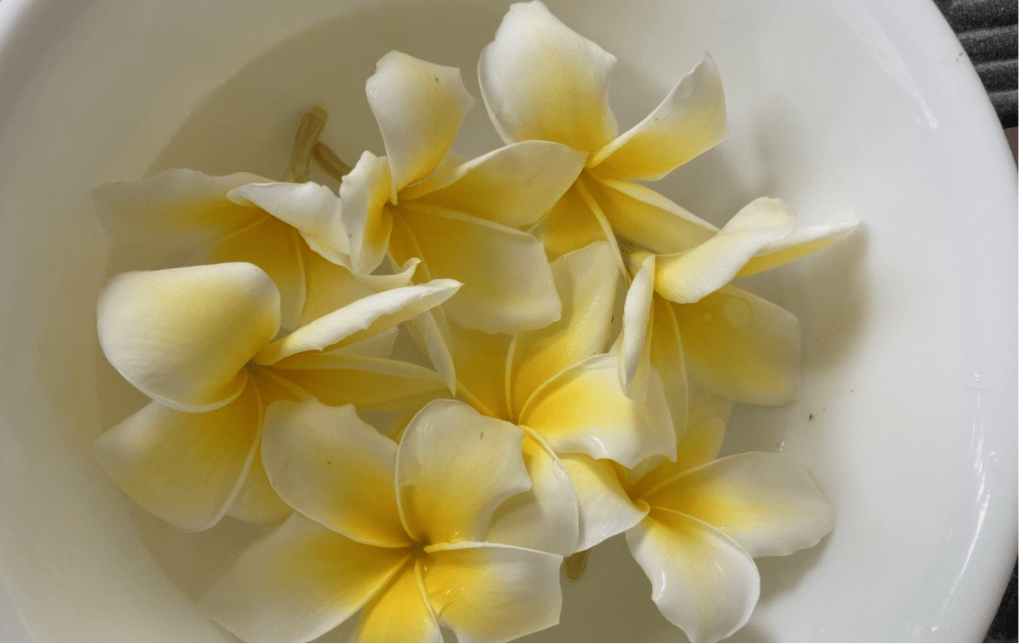
The Rose
In “The Little Prince” by Antoine de Saint-Exupéry (Mrs. Hanamoku’s favorite book), the rose tells the Little Prince that she is unique and special, despite there being many other roses in the world. She explains that to the Little Prince, she is not just another rose, but rather, she is his rose, making her unique in his eyes.
It doesn’t mean the eight plumeria from our kind neighbor is less important. But it’s meaning to us is different. Its value to us is one born of friendship. The meaning of our one plumeria is one our dedication, care, the experience, what we learned. We didn’t work on our neighbor’s plumeria and don’t know much about what he put into it.
A Zen Story
The Zen koan, “If you meet the Buddha on the road, kill him” is one of those Zen things that is absolutely preposterous at first. But as seemingly ludicrous as it is, as with many things Zen, it is a saying that is a profound teaching. Obviously, it isn’t meant to be taken literally but is rather a metaphorical instruction in Zen Buddhism. Let’s look a little deeper look into its meaning.
The phrase suggests that one should not idolize even the Buddha, the founder of Buddhism. This idea is meant to prevent students from becoming overly attached or dependent on the personification of Buddha or any other spiritual figure, understanding that enlightenment and spiritual insight come from within, not from external figures. Zen is a skill.
In fact, one of the Judaism/Christianity’s Ten Commandments is to not worship false idols. The Eternal Fishnu says that indeed, this is the real meaning of the commandment. Attachment to anything while existing within a living God or Universe will leave us behind.
It’s a warning against clinging too rigidly to teachings and doctrines, even those of Buddhism itself. Zen Buddhism, in particular, emphasizes direct experience and personal internal realization over rote adherence to scripture and traditional teachings. The phrase encourages practitioners to go beyond the words and teachings, even those of the Buddha, to find their own path to enlightenment.
It really is the “Yin to the Yang” of impermanence. A central tenet of Buddhism is constant change. It would be quite ironic for Buddhist teaching to remain static. Even for Buddha’s, every now and then, a new Buddha does come along. The Buddha of the Future is Maitreya, who will appear after the teachings of the current Buddha, Siddharta Gautama (whose enlightenment we observe on Bodhi Day), has vanished.
Even the most sacred and revered figures and concepts are not exempt from the law of impermanence. Attachment to these figures or ideas can be a barrier to understanding the true nature of reality.
Zen is about the direct experience of reality, as opposed to intellectual understanding or theoretical knowledge. By “killing the Buddha” one is encouraged to directly experience life and reality without the filter of religious or spiritual dogma.
Nothing is certain. And that’s wonderful!

Bodhi Day
Bodhi Day is just a few weeks away on Friday, December 8.
As a business intelligence developer, it might be an interesting Bodhi Day for us. Over the six year history of this site (and the sister site, fishnu.org – The Teachings of the Eternal Fishnu), we barely ever showed up on Google searches for the key words: Bodhi Day. But at least for the last few weeks, we show up in the 2nd slot (after all the ads) only under the Wikipedia entry for Bodhi Day.
So I imagine there might be many folks new to the site through the two Bodhi Days (the upcoming secular, Dec 8, 2023 and the lunar, Jan 18, 2024). Towards the bottom of the home page are links to the other “Bodhi Seasons” over the these past years. Each year I posted a series of blogs during week leading up to Bodhi Day. I think this one from 2018 kicks off a series that I remember fondly.
Faith and Patience,
Reverend Dukkha Hanamoku
 Bodhi Day